The Gatekeepers of the Lineup: Duck Dive vs Turtle Roll
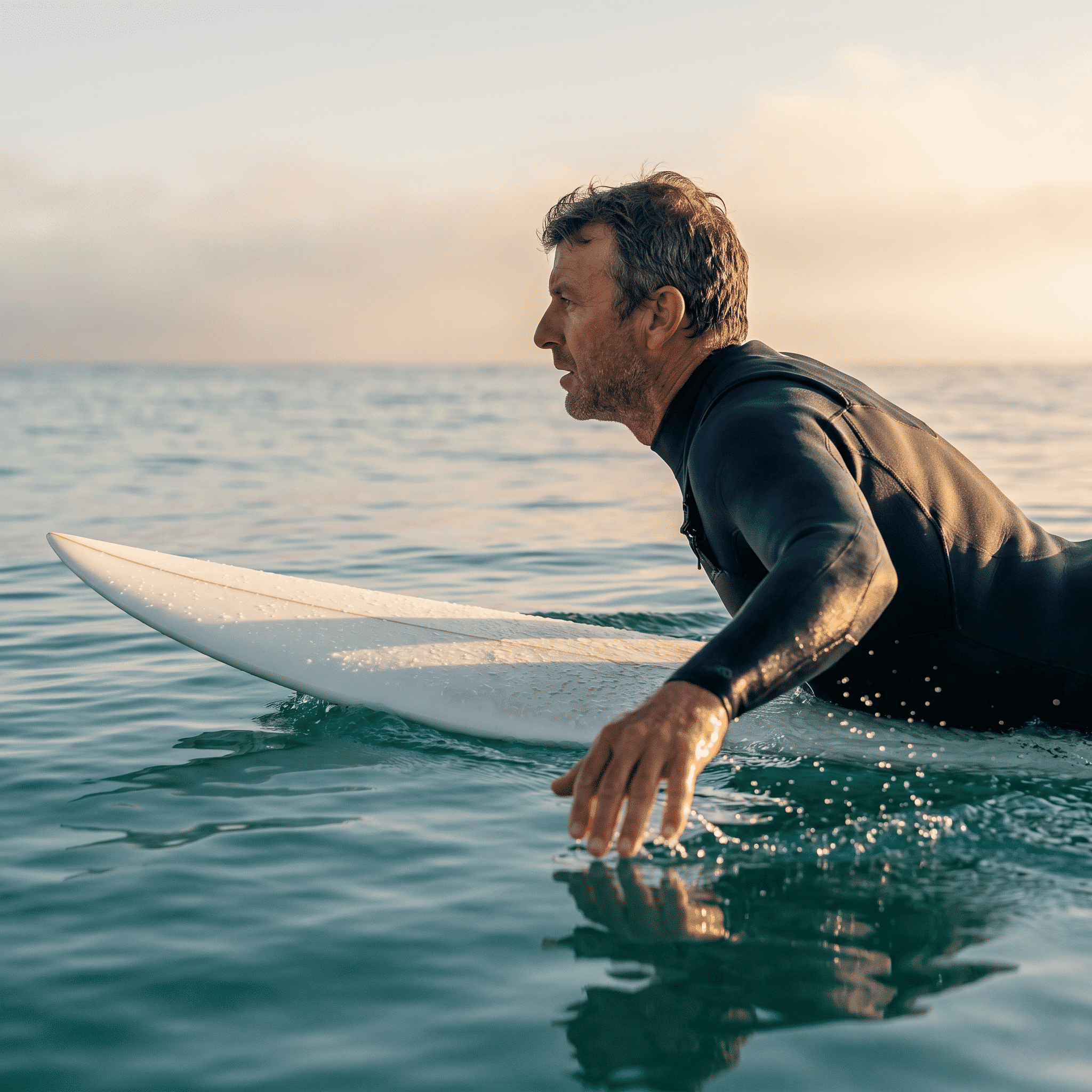
There is a specific moment, just as you step off the damp sand and into the shallows, where the ocean lays out its terms. The crisp, clean smell of paraffin wax mixes with the raw, metallic tang of kelp and salt. In the distance, you hear the heavy, low-frequency thud of a set breaking on the sandbar—a sound that vibrates straight through your chest. To reach the glassy faces waiting in the lineup, you have to cross the impact zone. This is the ocean’s tax collector, and it demands either flawless technique or a long, exhausting swim back to shore. How you pay that tax depends entirely on two fundamental maneuvers: the duck dive and the turtle roll.
Every surfer remembers the early days of fighting the foam. In my case, it was a cold autumn morning on an unforgiving beach break. I was armed with a high-volume board and an excess of ego, trying to muscle my way through a relentless six-foot set. I tried to push my board over the whitewater, only to have the wave grab the foam, flip me backward, and drag me across the shallow sandbar like a ragdoll.
That morning taught me a permanent lesson: you do not negotiate with the ocean’s energy. You must learn to glide beneath it or work with its momentum. Choosing between the duck dive and the turtle roll is not a matter of style; it is a mechanical decision dictated by your equipment and the physics of water displacement.
Understanding these two techniques is the dividing line between being a spectator on the inside and finding your flow in the lineup. As you transition from high-volume beginner boards to sleeker, more refined shapes, your playbook must evolve to match your gear. Mastering these survival tactics is an absolute necessity if you want to graduate to more advanced Surf Techniques for Intermediate Surfers. Without a reliable way to get past the breaking waves, you will exhaust your shoulders before you ever have the chance to stand up on a clean face.
The Core Breakdown: Comparing Duck Diving and Turtle Rolling
To understand why these maneuvers work, you have to understand the behavior of a wave. A breaking wave is not just water moving forward; it is a circular wheel of energy spinning toward the shore. The whitewater on the surface is chaotic and turbulent, filled with trapped air that reduces your board’s buoyancy. Directly beneath that foam lies a zone of relatively calm, stable water. The goal of both the duck dive and the turtle roll is to place your board and body in that stable zone, allowing the kinetic energy of the wave to pass over you without dragging you backward.
However, the way you achieve this submersion depends entirely on the volume of your surfboard. A low-volume shortboard has very little buoyancy, meaning you can easily sink it beneath the surface using your body weight. A high-volume longboard, on the other hand, wants to float. Trying to push an eighty-liter log underwater is like trying to push an inflated exercise ball to the bottom of a swimming pool—it will violently resist and shoot back up. This is where the mechanics diverge.
| Feature / Metric | The Duck Dive | The Turtle Roll | |
|---|---|---|---|
| Optimal Board Volume | Low volume (typically under 40-45 liters) | High volume (typically 50 to 100+ liters) | Low to mid volume (under 45 liters) |
| Primary Board Types | Shortboards, fish, step-ups, low-volume hybrids | Longboards, foamies, funboards, heavy mid-lengths | Shortboards, step-ups, narrow hybrids |
| Core Physics Principle | Submerging board and body under the wave’s path | Using the body as an underwater sea-anchor | Submerging board and body under the wave’s path |
| Physical Demand | High upper body, core, and leg strength | Moderate upper body grip and core control | High upper body, core, and leg strength |
| Timing Margin for Error | Very tight; requires split-second precision | Forgiving; can be set up several seconds early | Very tight; requires split-second precision |
| Efficiency in Large Surf | Extremely high; cuts through heavy energy | Moderate; requires immense grip to hold the log | Extremely high; cuts through heavy energy |
Anatomy of the Duck Dive: Sinking Beneath the Energy
“The duck dive is one of the most satisfying feelings in surfing. When executed correctly, you slice through the face of a clean wave or slip under a wall of whitewater with zero resistance, popping out the back with a clean splash of cold water on your face. But it is a complex, multi-step movement that requires your entire body to work in unison. It is a dance of timing, leverage, and core engagement. To maximize your leverage during the dive, having a reliable anchor point underfoot is critical; I always rely on heavy-duty, high-grid tail pads from industry benchmarks like FCS to ensure my back foot never slips when driving the tail down into the pocket.”
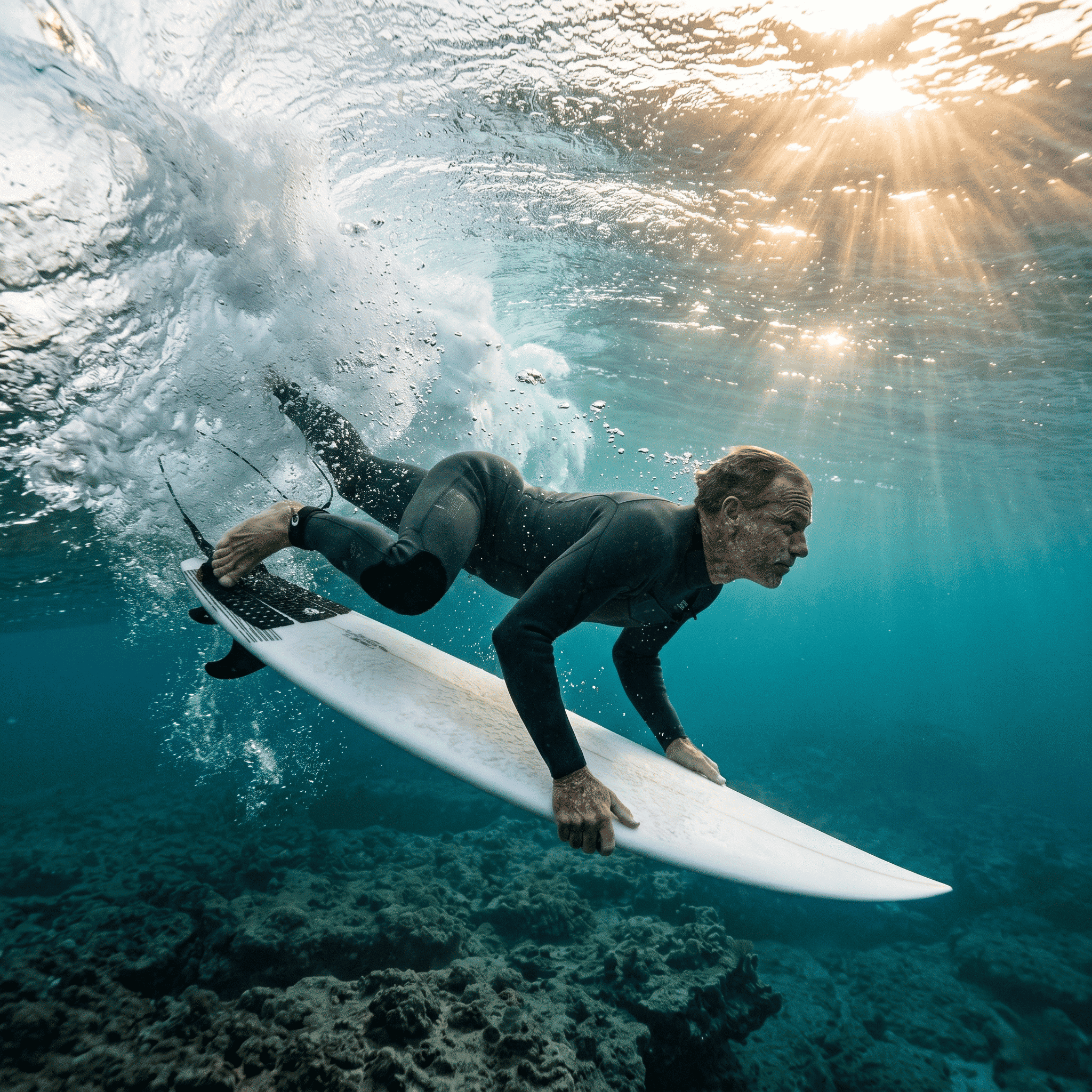
To perform a successful duck dive, you must build momentum. Never try to duck dive from a standstill; you need forward speed to carry you under and through the wave’s kinetic force. As the wave approaches—roughly one board-length away—grab your rails near your chest. Extend your arms fully, arching your back and pushing the nose of your board straight down into the water. As the nose begins to submerge, transition your weight forward, using your shoulders and chest to drive the front of the board as deep as possible.
Once the nose is down, it is time for the scoop. Take your dominant foot (or knee, though your foot provides vastly more control) and place it firmly on the tail pad. Drive your foot down and forward, forcing the tail of the surfboard to follow the nose into the water. This flattens the board out under the surface. Pull your body down close to the deck of the board to minimize your profile. As the wave passes overhead, look up, arch your back slightly, and allow the natural buoyancy of your board to lift you up and out behind the wave.
When I tested various board shapes at a heavy beach break in France, I realized how critical foot placement is on the tail. A lot of intermediate surfers make the mistake of using their knee to push down the tail. This dings the deck of your board over time and limits your leverage. By using the ball of your foot on the tail kick-tail, you can use your calf muscle to push the tail down much deeper, creating a sharper underwater arc. Another crucial tip: keep your eyes open.
It is a wild, beautiful world under the water, and seeing the vortex of the wave pass over your head allows you to time your upward scoop perfectly, rather than guessing in the dark.
Anatomy of the Turtle Roll: Managing Heavy Foam
The turtle roll (often called the Eskimo roll) is the classic longboarder’s answer to the impact zone. When you are paddling a nine-foot single-fin log, you cannot dive under the wave. Instead, you must use the volume of your board to protect you, turning upside down so the wave slides over the bottom contour of your board while you hang securely underneath, acting as a heavy sea-anchor.
The key to a successful turtle roll is early preparation. Paddle straight toward the oncoming wave with speed. If you are angled even slightly sideways, the wave will catch your rail and wash you toward the beach. When the wave is about six feet away, slide your hands down the rails to a position near your shoulders. Take a deep breath of fresh air, grip the rails with maximum force, and flip yourself over by rolling your shoulders and hips to one side. You should now be upside down in the water, looking up at the bottom of your surfboard.
While upside down, do not let your board float away from you. Pull the board down close to your chest, but keep your elbows slightly bent to absorb the impact. Crucially, leave a small pocket of space between your chest and the board. If you clamp the board flat against your chest, the wave’s impact will transfer directly into your ribs. By keeping your elbows bent and your body hanging below, you allow your physical weight to anchor the board in place. Once you feel the rumble of the whitewater pass over, use your core to twist your hips, pulling yourself back up onto the deck, ready to paddle again.
Over years of riding heavy logs on crowded point breaks, I have discovered a common failure point: surfers often roll too early and lie flat underwater, waiting for the wave. If you roll too early, you lose all forward momentum, and the wave will drag you backward anyway. Wait until the wave is almost upon you before you commit to the flip. Also, keep your legs hanging straight down. It might feel natural to curl up into a ball, but letting your legs dangle acting as a deep vertical rudder stabilized by your wetsuit keeps the nose of your board pointed straight into the wave, preventing the whitewater from spinning you sideways.

Volume and Hydrodynamics: Why Your Equipment Makes the Decision
The choice between these two techniques is almost entirely determined by the volume of your surfboard. Volume represents displacement, which is a measure of how much water your board pushes out of the way to float. If you try to duck dive a board with more than forty-five liters of volume (unless you weigh over two hundred pounds), you will struggle to get the nose deep enough to clear the turbulent surface energy. The board will simply bounce back, hitting you in the face or ripping out of your hands.
Conversely, trying to turtle roll a low-volume shortboard is highly inefficient. Because a shortboard has very little surface area, it does not offer enough protection or stability when flipped upside down. The wave will easily wrap around the narrow rails, rip the board out of your grip, and send it tumbling. You must align your technique with the tool under your chest.
When you are navigating the transition phase of your surfing journey, moving from a heavy foamie to a mid-length or a hybrid fish, you will enter a grey zone. A 42-liter hybrid board can be duck-dived, but it requires near-flawless mechanics and an aggressive push. On clean, small days, a duck dive on a mid-length is possible if you sink the rail first, slicing the board into the water at an angle rather than trying to push the entire flat surface down. Understanding these subtle hydrodynamic realities is what keeps you calm, collected, and breathing steady when the horizon turns dark with an incoming set.
Situational Intelligence: Reading the Set and Choosing Your Battle
The ocean is dynamic, and survival in the impact zone requires more than just mechanical execution. It requires situational awareness. You must read the incoming waves and understand how they are interacting with the bottom contours of the beach or reef. A clean, green wave that has not broken yet requires a completely different approach than a six-foot wall of churning, bubbly whitewater.
When you are faced with a clean wave that is about to break directly on top of you, a deep duck dive is your only option on a shortboard. You must time your dive so that you are at the deepest point of your arc just as the lip of the wave impacts the surface. If you dive too early, you will begin rising too soon and get sucked up into the lip, performing an involuntary underwater cartwheel. If you dive too late, the falling lip will smash directly into your back.
If you are riding a longboard and a massive set is breaking far outside, you must prepare yourself for multiple turtle rolls. This is where pacing your breath is vital. When you are underwater, hanging beneath your board, relax your muscles. Do not fight the water or panic. Let the wave do its work, hold your grip on the rails, and wait for the turbulent hiss of the foam to fade before you pull yourself back up.
If you panic and let go of your board, you put everyone paddling behind you in serious danger. Your leash is not a lasso; it is a safety device of last resort. Keeping hold of your board is the ultimate sign of respect in any lineup.
Frequently Asked Questions About Ocean Navigation
Can you duck dive a funboard or a mini-malibu?
Generally, no. Most funboards and mini-malibus have volumes ranging between 45 and 60 liters, combined with wide noses. This makes them far too buoyant to push underwater with standard body weight. For these boards, the turtle roll is the correct and most efficient technique to get through the whitewater safely.
How do I stop my board from being ripped out of my hands during a turtle roll?
This usually happens because you are rolling too early, losing your forward momentum, or because you are keeping the board too far from your body. Make sure you paddle with speed right up to the wave, and when you flip, pull the board close to your chest with your elbows bent. This prevents the rushing water from getting between you and your deck, which acts like a sail and tears the board from your grip.
Is it ever okay to ditch my surfboard and dive deep under a wave?
Ditching your board should be your absolute last resort, only done in extreme, life-threatening situations where a massive set is breaking directly on your head and you cannot dive or roll. Before you ditch, you must look behind you to ensure there are no other surfers in your path. A loose board on a ten-foot leash becomes a dangerous projectile that can cause severe injury to others.
Why do my ears hurt when I duck dive?
When you duck dive deep, the water pressure increases rapidly. Just like scuba diving, you need to equalize your ears. You can do this by gently pinching your nose and blowing slightly through your nose as you dive, or by swallowing. If you experience sharp pain, do not force the dive; return to the surface to prevent damage to your eardrums.
Should I use my knee or my foot to push the tail down during a duck dive?
While using your knee is easier for beginners to learn, you should transition to using your foot as soon as possible. Using your foot gives you a longer range of motion, allowing you to push the tail much deeper. It also protects the deck of your board from pressure dings caused by your kneecap.