The Unforgiving Truth About Paddling
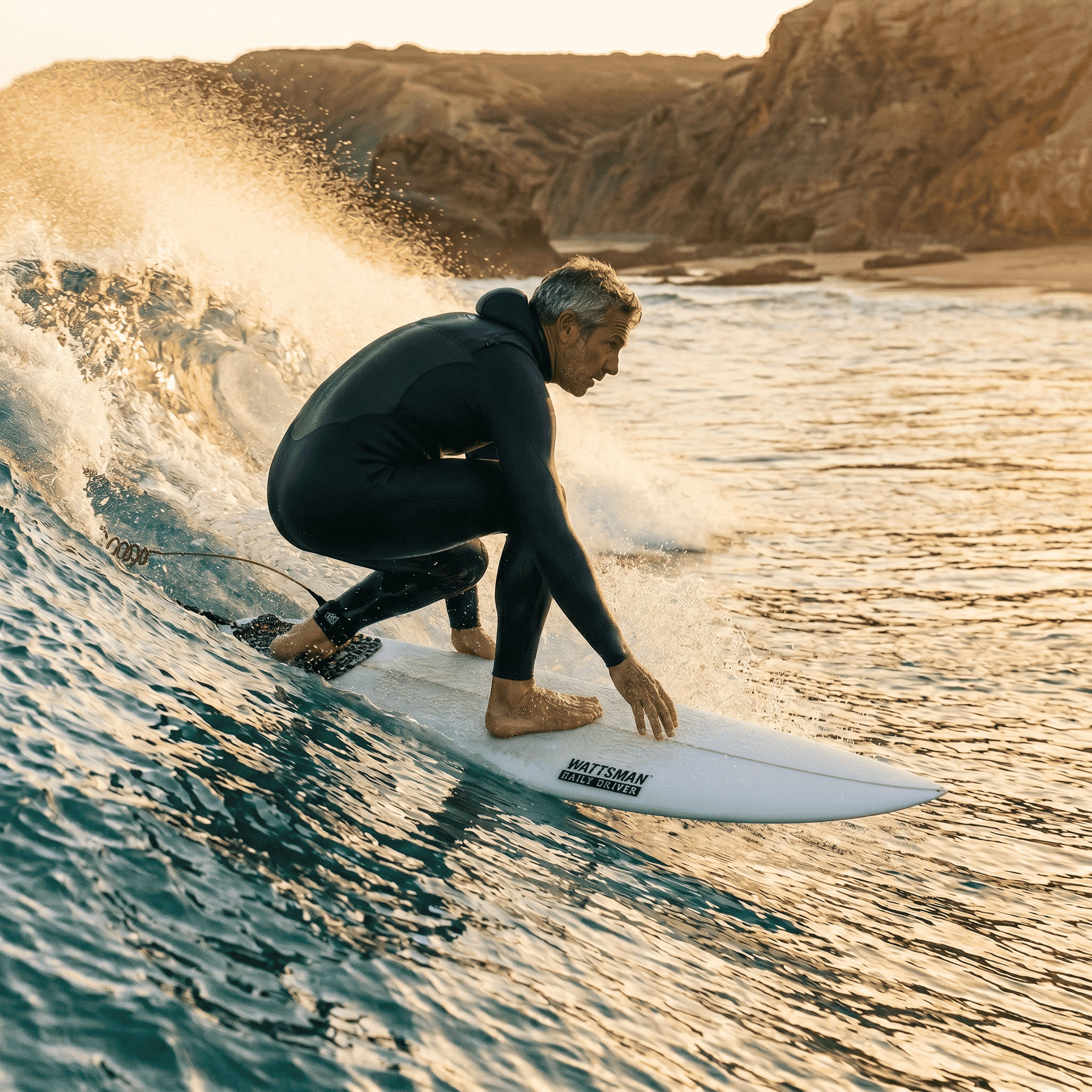
Every surfer remembers the day they realized that surfing is not actually about standing on a board. In my twenty years of chasing swells from the cold, raw slabs of the Pacific Northwest to the boiling reefs of Indonesia, I have learned one humbling truth: surfing is 80% paddling, 10% waiting, and maybe 10% riding. I still remember sitting on the beach at Uluwatu as a teenager, watching clean, double-overhead lines march in while my shoulders burned with a deep, white-hot fatigue. I had spent the previous hour fighting a relentless sweep, swallowing liters of brine, and ultimately pearling on the only wave I managed to turn for.
My lats felt like lead, my chest was raw from the wax, and my ego was thoroughly bruised. That day, I realized that paddling isn’t just a means of transportation; it is the absolute foundation of your relationship with the ocean.
When you lack paddling power, the ocean becomes a hostile environment. You miss sets, you get caught inside, and your confidence crumbles before you even stand up. Conversely, when your paddling strength is dialed in, the lineup transforms. You glide effortlessly through the rip, beat the crowd to the peak, and chip into waves early with clean, steady momentum.
To get to that level, you must understand that water density is roughly 800 times greater than air. Brute force will only get you so far before lactic acid shuts your shoulders down. True paddling endurance is a fusion of hydrodynamics, functional muscle recruitment, and mental grit. Let’s break down exactly how to rebuild your paddle engine from the bone up.
The Anatomy of an Efficient Paddle Stroke
Before we discuss building raw horsepower, we must look at your vehicle’s aerodynamics—or rather, its hydrodynamics. In my early days, I watched countless eager surfers paddle like they were trying to climb a ladder, thrashing their arms wildly and swinging their hips from side to side. This creates immense drag. To paddle efficiently, you must turn your body into a sleek, rigid hull.
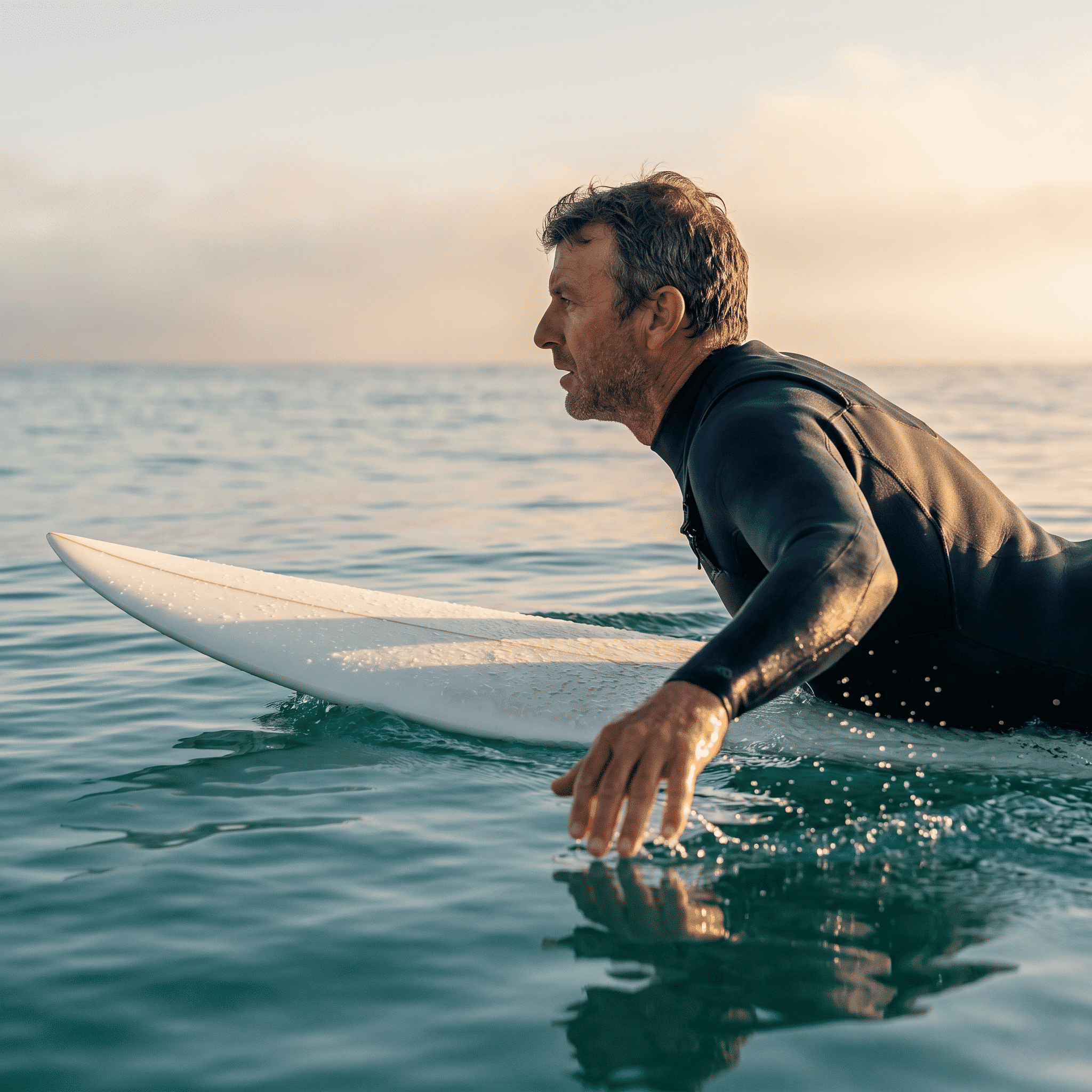
This begins with your board trim. If you sit too far back on your board, the tail sinks, acting as an anchor. If you sit too far forward, the nose plunges under the water, a mistake known as pearling. Ideally, you want the nose of your board to hover exactly one inch above the surface of the water, perfectly flat.
Once your trim is established, your posture must follow. Arch your lower back, lift your chest high off the deck, and keep your chin up. When I tested this positioning early in my journey, I immediately noticed how it shifts your weight toward your hips, freeing up your shoulders for a full range of motion. This active cobra pose engages your erector spinae and glutes, creating a solid, stable platform. Your head should remain completely still; any side-to-side head shaking translates directly into lateral board wobble, which kills your forward momentum.
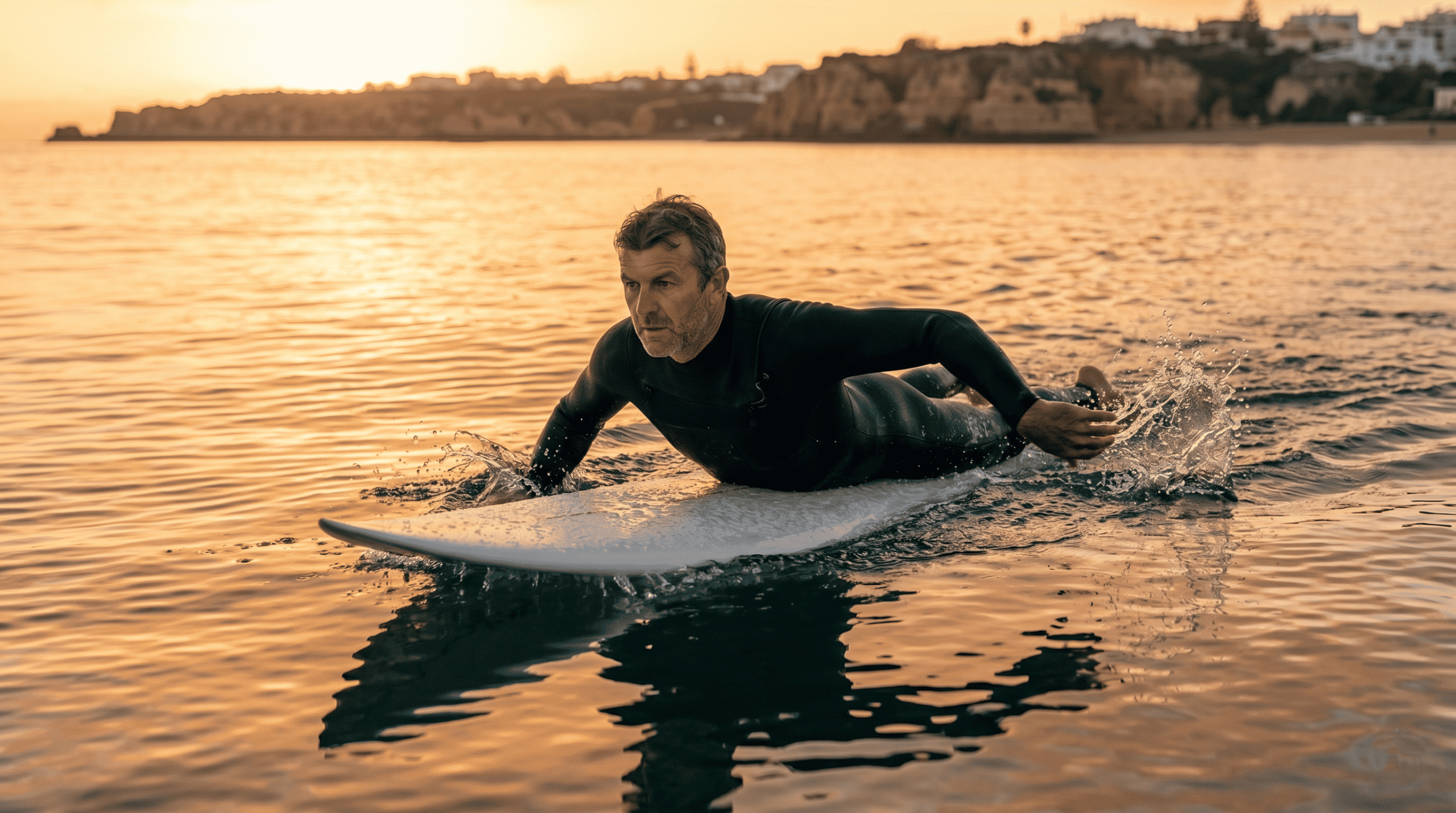
The stroke itself can be broken down into four distinct phases:
- The Entry and Reach: Extend your arm forward, entering the water clean and quiet with your hand slightly cupped but relaxed. Enter fingertips first, about a foot to eighteen inches in front of your shoulder. Avoid crossing your hand over your board’s stringer, as this causes snake-like yawing.
- The Catch: This is where true power is generated. Do not pull immediately with a straight arm. Instead, drop your elbow slightly and “hook” the water with your forearm and hand. You are trying to grab a solid block of water. This engages your latissimus dorsi—the large muscles of your back—rather than putting all the strain on your smaller rotator cuffs.
- The Pull: Accelerate your hand straight back, close to the rail of your surfboard. Think of it as pulling your body past your hand, rather than pulling your hand through the water. Keep your forearm vertical to maximize surface area.
- The Release and Recovery: As your hand reaches your thigh, exit the water cleanly. Relax your arm on the recovery phase, swinging it low and wide over the water back to the entry point. This brief recovery phase is where your muscles find a millisecond of rest.
Mastering these fundamentals is a core pillar of Surf Techniques for Intermediate Surfers , as physical power is useless without correct hydrodynamics. If you are constantly fighting your own board’s drag, even the strongest shoulders will redline within minutes.
Dryland Training: Building Surf-Specific Muscle Off the Water
Let’s be honest: unless you live directly on the sand and can paddle every single day, you need to build your surf fitness on land. When I transitioned from a weekend warrior to a dedicated, year-round surfer, my dryland routine had to evolve. Standard gym routines built around heavy bench presses and isolated bicep curls are actually counterproductive for surfing. They build heavy, bulky muscles that require excessive oxygen, causing you to gunk up with lactic acid almost instantly. Instead, we need to focus on muscular endurance, thoracic mobility, and shoulder joint stability.
To mimic the unique physical demands of paddling, your dryland training should center on posterior chain activation and shoulder health. The rotator cuff muscles (supraspinatus, infraspinatus, teres minor, and subscapularis) act as the stabilization steering wheel for your shoulders. If they are weak, your big prime movers—the lats and deltoids—will pull the humeral head out of its sweet spot, leading to the dreaded “surfer’s shoulder” impingement. Here are three non-negotiable dryland exercises that I swear by:
1. Resistance Band Lat Pull-Downs & Face Pulls
Anchor a high-quality resistance band from industry benchmarks like TheraBand to a door frame or post at head height. Kneel down, mimic your paddling arch, and pull the bands down toward your hips, focusing entirely on squeezing your shoulder blades together at the bottom of the movement. For face pulls, pull the band directly toward your nose, flaring your elbows outward. This strengthens the rear deltoids and middle trapezius, correcting the rounded-shoulder posture that plagues many modern desk workers.
2. The Swiss Ball Cobra
Lie stomach-down on a Swiss ball with your feet anchored against a wall. Raise your chest off the ball, extending your spine. Bring your arms out to your sides in a “Y” or “T” position, thumbs pointing toward the sky. Hold this isometric contraction for 30 to 60 seconds. This builds the brutal lower-back and neck endurance required to keep your head up during a long three-hour session without cramping.
3. Kettlebell Halos and Single-Arm Rows
Holding a moderate kettlebell by the horns, rotate it smoothly around your head in a tight circle. This lubricates the shoulder joints and builds dynamic core stability. Follow this with heavy single-arm rows, focusing on pulling the weight toward your hip rather than your chest, simulating the exact pulling motion of a high-performance paddle stroke.
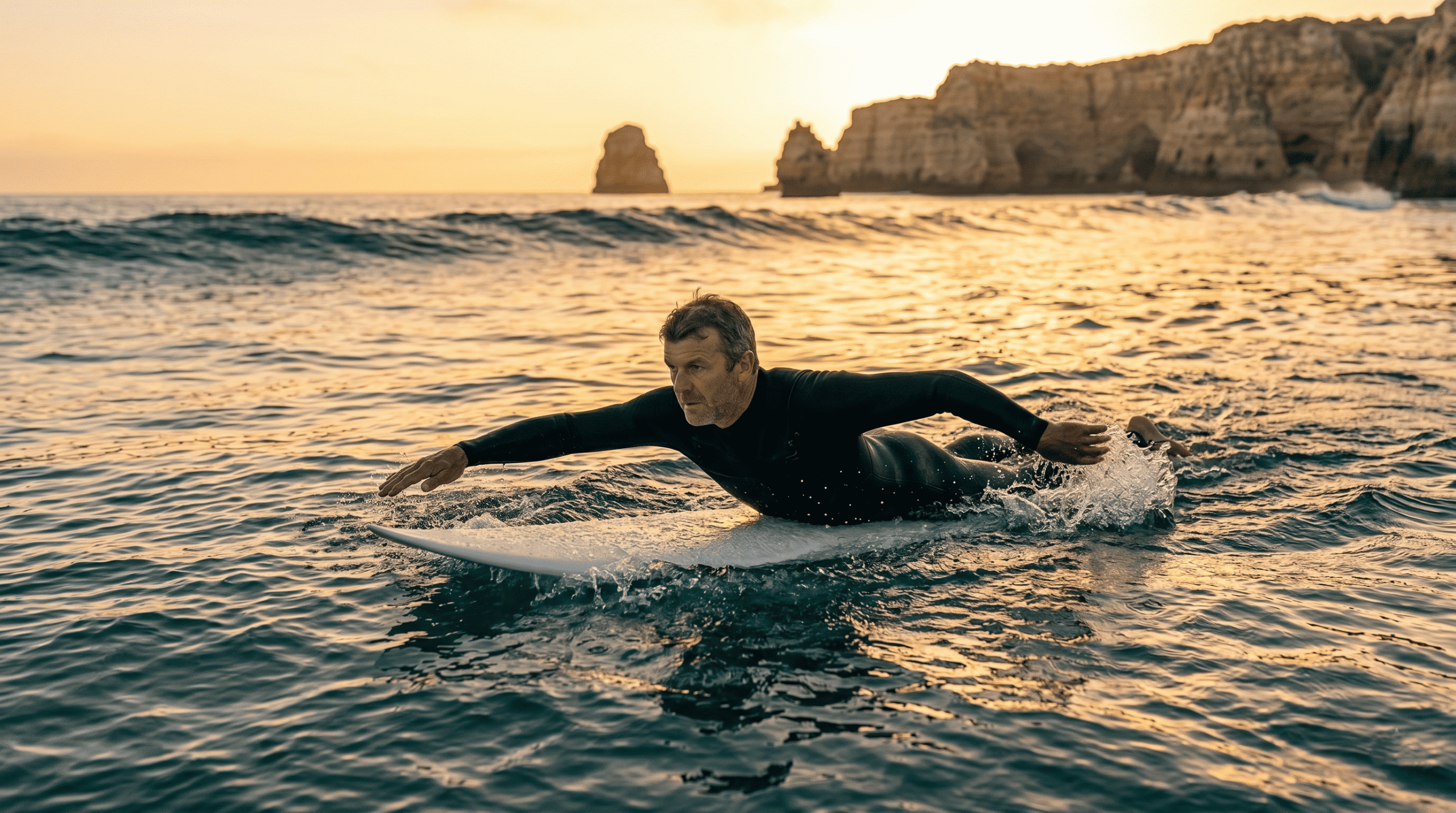
In-Water Conditioning: The Ultimate Surf Gym
While dryland training builds the structural foundation, there is absolutely no substitute for actual wet-work. The hydrodynamic drag of water, the instability of the floating board, and the cold temperature create a unique sensory environment that cannot be replicated in a climate-controlled gym. If you want to build iron-clad paddling endurance, you must commit to dedicated water conditioning sessions, even when the waves are flat and uninviting.
When the ocean goes flat for weeks, I pack up my longboard or high-volume funboard and head to the nearest lake, harbor, or calm bay. This is where you can isolate your stroke mechanics without the distractions of waves, currents, and lineup etiquette. I recommend implementing a structured interval training format. Treat your board like a track athlete treats a running oval:
The Flat-Water Paddle Interval Routine: Start with a gentle 5-minute warm-up paddle, focusing entirely on perfect form, quiet hand entries, and keeping your chest high. Once warm, transition into sprint intervals: paddle at 90% max effort for 30 seconds (simulating sprinting to catch a heavy set wave), followed by 60 seconds of slow, active-recovery paddling. Repeat this cycle 10 times. To finish, perform a continuous, steady-state paddle for 15 to 20 minutes at a moderate, conversational pace. This dual-energy-system training conditions both your aerobic system (for long paddles back to the lineup) and your anaerobic system (for quick bursts of speed to catch waves or escape clean-up sets).
If you do not have access to open flat water, your local swimming pool is an exceptional training ground. Swimming laps with a pull buoy between your legs is a fantastic way to isolate your upper body and mimic the leg-inactive posture of surfing. Focus on the freestyle stroke, but emphasize a high-elbow catch and a long, rolling glide. Swimming builds lung capacity and cardiovascular efficiency, teaching your body to stay calm when your heart rate spikes during intense ocean hold-downs.
Comparing Training Methods: Dryland vs. Wet-Work
To maximize your training efficiency, it is helpful to understand how different conditioning modalities compare. No single training style does it all; the key is blending land-based strength with real-water application to build a resilient, injury-resistant body.
| Training Modality | Primary Muscle Targets | Convenience Factor | Aerobic/Anaerobic Benefit | Transfer to Surfing Performance |
|---|---|---|---|---|
| Resistance Bands & Mobility | Rotator Cuff, Rear Delts, Rhomboids | Very High (Can do anywhere) | Low (Focus is structural) | High (Prevents shoulder injuries and improves joint range) |
| Swimming (Pool Laps) | Lats, Core, Cardiovascular System | Moderate (Requires pool access) | High Aerobic & Cardiovascular | Moderate-High (Great for lung capacity and stroke rhythm) |
| Flat-Water Board Paddling | Full Posterior Chain, Lats, Neck/Lower Back | Low (Requires board & water body) | Excellent Dual-System Training | Maximum (Identical muscle recruitment and board feel) |
| Gym Weight Training | Glutes, Erector Spinae, Traps, Chest | Moderate (Requires gym membership) | Low-Moderate (Depending on rest) | Moderate (Builds raw power, but can limit flexibility if overdone) |
Insider Secrets Only Years in the Lineup Can Teach You
Over the years, I have realized that the strongest paddlers in the water are often not the most muscular individuals. They are the ones who have developed a deep, intuitive understanding of fluid dynamics and energy conservation. When you watch a seasoned local glide out to the peak, they look like they are barely working, yet they cover ground twice as fast as the tensed-up beginner thrashing next to them. Here are a few hard-won, salt-crusted secrets to immediately elevate your water efficiency:
First, learn to “feather” your paddle stroke depending on the situation. You do not need to pull at 100% effort all the time. When you are paddling back out through a calm channel after a wave, drop your intensity to about 50%. Relax your hands, open your fingers slightly, and focus on deep, rhythmic belly breathing. This slow, steady paddling keeps you moving while allowing your heart rate to drop and your muscles to clear out metabolic waste. Save your explosive 100% energy for the 5 to 6 critical strokes needed to match the speed of an approaching swell.
Second, respect the power of the “S-stroke” myth. For decades, old swimming manuals taught people to pull their hands in an “S” pattern under their body. In the ocean, this is a recipe for shoulder instability and lost power. Pull straight back parallel to your rail. To increase your leverage, think about applying pressure downward and backward against the water, using your core to press your surfboard down. This creates lift at the nose of your board, helping you hydroplane over the water rather than plowing through it.
Finally, utilize the ocean’s natural highways. Never try to fight your way straight through a heavy breaking zone if a rip channel is nearby. Look for the dark, deep, choppy water where the waves are not breaking clean; this is a rip current pulling water back out to sea. Sit on your board, let the conveyor belt do the heavy lifting, and conserve your precious arm strength for when you actually need to turn around and scratch into the wave of the day.
Frequently Asked Questions
How long does it take to see noticeable improvements in paddling strength?
If you commit to a consistent routine of dryland mobility work twice a week and at least one dedicated flat-water paddle or swim session, you will begin to notice a dramatic shift in your endurance within 4 to 6 weeks. Your muscles will adapt to the continuous back extension, and your cardiovascular recovery times between sets will shorten significantly.
Why do my neck and lower back hurt so much after a long surf session?
This is incredibly common and is almost always caused by a lack of thoracic extension and weak glutes. If your upper back is stiff from sitting at a desk all week, your body will force your neck and lower lumbar spine to over-compensate to keep your head up. Focus heavily on thoracic mobility stretches, such as foam rolling your upper back, and strengthen your glutes and erector spinae with back extensions and deadlifts.
Should I keep my fingers together or spread apart when paddling?
Keep your fingers slightly spread—about a natural finger-width apart—rather than tightly squeezed together. Fluid dynamics studies have shown that a slightly open hand creates a boundary layer of water between the fingers, effectively creating a larger “paddle” surface area without the muscle tension required to hold your fingers tightly shut. Keep your hands relaxed, not rigid.
Can I use a surfskate or skateboard to improve my paddling strength?
While surfskates are incredible tools for practicing your carving, compression, and wave-riding mechanics, they do very little for your actual paddling strength. Paddling requires resistance against a fluid medium and unique posterior chain endurance that can only be effectively trained on a surfboard, a swimming pool, or with targeted resistance bands.