
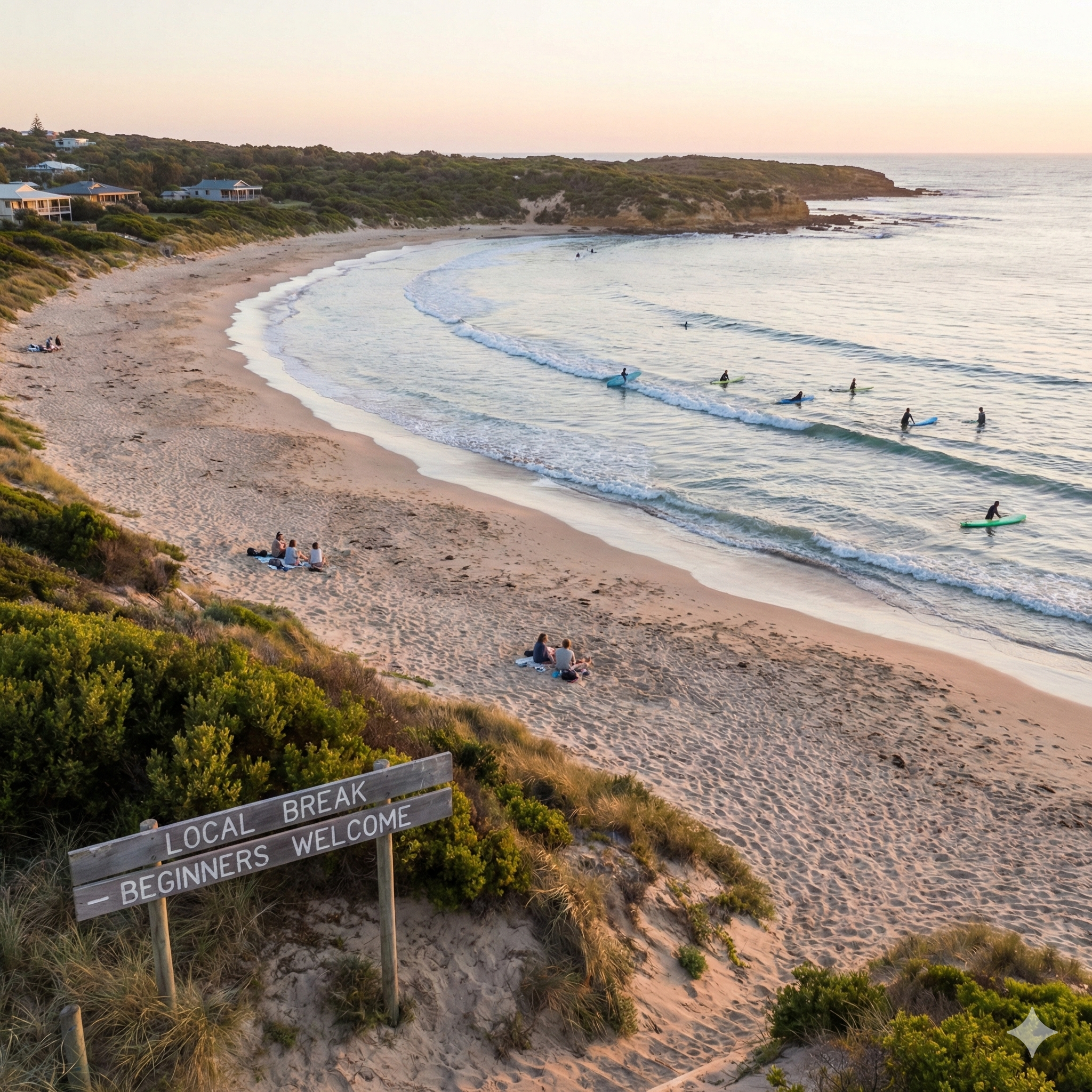
When you start surfing, everyone talks to you about the “best beaches,” the famous spots, and the perfect waves. But what nobody tells you is that many of those world-renowned beaches are absolutely terrible for beginners.
I fell into that trap more than once. I remember traveling to a very famous spot (the kind that looks perfect in photos) thinking I was about to have the session of my life. It ended up being a complete nightmare. I paddled out into a lineup with a shallow rock bottom, a strong sweeping current, and a peak crowded with aggressive locals who knew exactly what they were doing. I had no idea where to position myself. I spent more time dodging flying surfboards and surviving wipeouts than actually trying to surf.
That day taught me a vital lesso, a famous beach is not always a good beach to learn on If you want to progress, you need to know exactly what makes a beach beginner-friendly.
What Actually Makes a Beach “Beginner-Friendly”?
Over the years, I completely changed how I choose where to surf. I stopped looking for the most spectacular waves and started valuing much simpler, but far more important, elements.
- Sandy Bottoms (Beach Breaks)
- This is crucial. You want a “beach break,” which means the waves break over a submerged sandbar, rather than a “reef break” or “point break” where waves crash over sharp coral or solid rock. A sandy bottom allows you to make mistakes without fear. You can fall off your board a hundred times and get tumbled underwater without worrying about smashing your knees or head against a reef.
- Long Whitewater and Slow-Peeling Waves
- As a beginner, you don’t want fast, hollow waves that barrel, you need waves that break softly and crumble slowly. Even better, you want a beach that produces long lines of whitewater (the foam). Long whitewater gives you the time you desperately need to react, find your balance, and practice your pop-up without the wave disappearing beneath you in a second.
- A Chill Vibe and Space to Fail
- Something that doesn’t seem important until you experience it is the vibe in the water. A crowded peak full of experts is intimidating and dangerous for a novice. You need a beach with enough space to spread out, where the atmosphere is relaxed, and where you have the room to make mistakes without the pressure of ruining someone else’s ride.
The Algarve (Portugal): A Masterclass in Beginner Beaches
If you want a real world example of what perfect beginner beaches look like, look no further than the Algarve and the southwest coast of Portugal, it’s a region blessed with consistent swells and miles of sandy breaks.
Here are two beaches that perfectly illustrate what you should be looking for when planning your first surf trip.
Praia do Amado: Space to Breathe and Progress.
Praia do Amado: Space to Breathe and Progress
Praia do Amado is the textbook definition of a beginner friendly beach, it is a massive stretch of sand with multiple peaks, which means the crowd naturally spreads out.
I had a session there that I will never forget, the swell was small and organized, offering incredibly long, forgiving lines of whitewater. Because there was so much space, I could catch wave after wave without any stress or chaos. I remember paddling back out to the peak and realizing something profound, I wasn’t nervous, I wasn’t overthinking my technique, I was just in the right place, doing what I had to do, and purely enjoying the glide, that is the exact environment you need to progress.
Praia da Arrifana: Beautiful but Demanding Respect
Arrifana is one of the most stunning beaches in Europe, tucked beneath massive cliffs, it is an excellent spot for learners, but it also taught me the importance of observation.
Depending on the day and the tide, Arrifana can be demanding, the first time I went there, I arrived with high expectations but also a healthy dose of respect, the waves were manageable and clean, but I still hesitated. Instead of rushing in, I sat on the sand for twenty minutes, I watched how the sets rolled in, where the waves were breaking, and where the safe channels were to paddle out.
When I finally entered the water, everything started to flow. It wasn’t my best session in terms of technical maneuvers, but it was one of the first times I felt like I truly understood the environment, I didn’t feel lost. I walked out of the water thinking, “Okay, this is finally starting to make sense.”
The Verdict: Choose Progression Over Pictures
Ultimately, the best beach for a beginner surfer is not the most famous one, nor the most spectacular one on Instagram, it is the beach that allows you to learn without fear, to make mistakes without severe consequences, and to actually enjoy the process. When you find a place like that, you stop fighting the ocean and slowly begin to feel like you are a part of it.
Before You Hit the Sand: Your Next Steps
Finding the perfect sandy beach is only half the battle. Once you are there, you need to know what to do when the water hits your knees.
If you have chosen your beach but still struggle with paddling efficiently, standing up without falling, or understanding ocean safety, you need a solid foundation before you paddle out. Check out our Ultimate Guide to Surfing for Beginners: How to Start and Not Give Up. It is the perfect companion to ensure your first trip to a beginner beach is a success, not a struggle.
Frequently Asked Questions About Beginner Surf Spots
What is the difference between a beach break and a reef break?
A beach break features waves crashing over a shifting sandy bottom, they are generally safer and more forgiving, making them ideal for beginners. A reef break features waves crashing over coral or solid rock, these waves are often more powerful, hollow, and extremely dangerous to fall on, making them strictly for advanced surfers.
Should I avoid surfing if a beach is crowded?
As a beginner, yes, you should avoid heavily crowded main “peaks.” Crowds increase the risk of collisions and create a stressful environment. Look for a beach break where you can walk a few hundred yards down the sand to find an empty spot of whitewater to practice on, away from the experienced surfers.
Why are the beaches in the Algarve (Portugal) so good for learning?
The southwest coast of Portugal, particularly the Algarve, faces the Atlantic Ocean, which provides highly consistent swells year-round, more importantly, the region is full of wide, sandy beach breaks (like Praia do Amado) that offer the safe, soft, and long-rolling waves that beginners need to practice their pop-ups safely.