When you first get the urge to surf, it’s easy to imagine that all you need is a board, some waves, and the willpower to paddle out. You picture yourself running into the ocean, catching a wave effortlessly, and walking back onto the sand looking like a pro.
Nothing could be further from the truth. You quickly learn that the right preparation and equipment are the difference between an incredible day and one you deeply regret.
The surf industry is massive, and it will try to sell you every gadget under the sun. But what do you actually need to start surfing? Not much. However, the few things you do need must be chosen wisely. Let’s break down the absolute essentials, the things that will protect you, and the “magic” accessories you should completely avoid.
The Golden Rule of Surf Gear: Protection Over Aesthetics
Looking back on my early days in the water, I realized something important: I used to think surf gear was just about looking cool or fitting into the culture. But the real purpose of your equipment is protection and comfort.
When you are protected from the sun, the cold, and the friction of the board, you can actually focus on reading the waves, paddling, and standing up. You stop worrying about scrapes or freezing water, and you start enjoying the moment. That level of comfort is what turns a frustrating first attempt into a memorable session.
The Absolute Essentials (Don’t Overcomplicate It)
If you are just starting, your shopping list should be incredibly short. Here is exactly what you need to get into the water safely.
The Surfboard: Why Foam is Your Best Friend
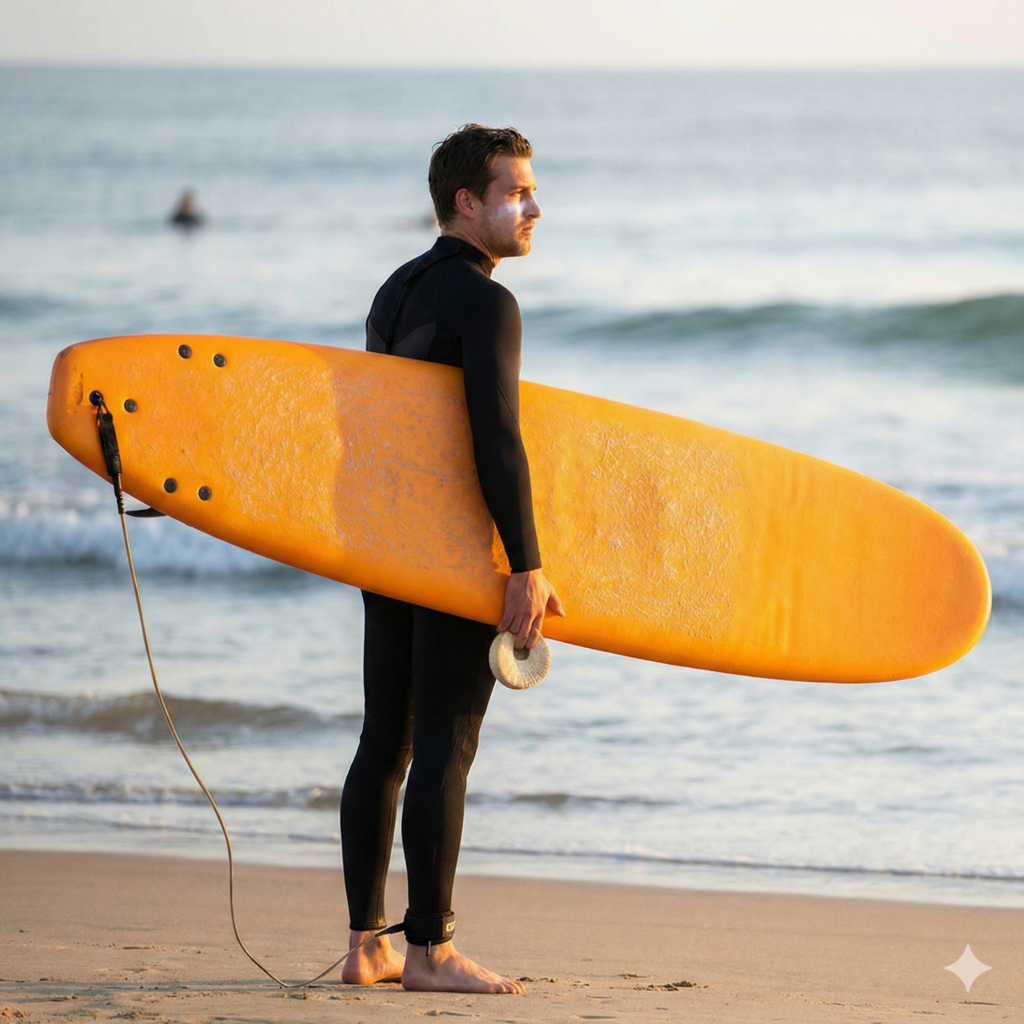
Do not buy a shortboard. Do not buy a high-performance fiberglass board just because it looks fast. Your first board should be a foam board (softboard), usually between 8 and 9 feet long.
Foam boards are buoyant, making them easy to paddle, and they are stable enough to give you time to find your balance. More importantly, they are soft. When you are learning, the board will hit you. A foam board will leave a bruise; a fiberglass board can send you to the hospital.
The Leash: Keep It Simple and Sized Right
The leash is the urethane cord that attaches your ankle to the tail of the board. It is your lifeline,it stops your board from becoming a dangerous projectile and saves you from swimming a mile to the shore after every wipeout.
A good rule of thumb is to buy a leash that is roughly the same length as your board (e.g., an 8-foot leash for an 8-foot board). I learned this the hard way. I once bought an exaggeratedly long leash thinking it would give me more freedom. Instead, it just tangled around my legs constantly, making my pop-ups impossible and causing me to trip over myself underwater. Keep it simple and sized correctly.
Protecting Your Skin: The Hard Lessons
The ocean is an abrasive environment. Between the saltwater, the sun, and the board itself, your skin takes a beating.
Wetsuits and Rash Guards
The first time I paddled out under a strong sun without a proper rash guard or wetsuit, I ended up completely peeled. I hadn’t realized how much constant friction there is between your stomach, your legs, and the wax on the board.
That severe “surf rash” and the sunburns taught me a harsh lesson: **surf clothing is armor.**
Warm Water: You need a high-quality rash guard (Lycra). It prevents the wax from tearing up your chest and provides crucial UV protection. Pair it with boardshorts that fit securely.
Cold Water: You need a wetsuit. A 3/2mm thickness is standard for mild climates, but if the water drops below 60°F (15°C), you’ll want a 4/3mm suit and possibly booties. The right wetsuit keeps you warm, which keeps your muscles loose and extends your session.
Surf Wax and Sunscreen: Small Details, Big Impact
Surf Wax: You need traction to stop slipping off the board. It seems like a minor detail, but using the wrong wax can ruin a session. Make sure you buy wax rated for the water temperature you are surfing in (Cold, Cool, Warm, or Tropical). If you use Tropical wax in cold water, it becomes as hard as a rock; if you use Cold wax in the tropics, it melts into a slippery mess.
Sunscreen: The water reflects UV rays, doubling your exposure. Use a heavy-duty, water-resistant, zinc-based sunscreen on your face, neck, and the backs of your hands.
What Beginners DON’T Need
When you are struggling to catch waves, it is tempting to look for shortcuts. The internet is full of “inventions” that promise to make surfing easier. Save your money.
I remember buying some sort of inflatable floatation device that claimed it would help me catch waves faster. It was a complete disaster. It was bulky, it got in the way of my paddling, and it just made maneuvering the board incredibly awkward.
Avoid webbed paddling gloves, “shark deterrent” bracelets (unless you are in a highly specific, high-risk area), or any gadget that promises to replace good technique. What truly matters is mastering the basics: a board suited to your level, a reliable leash, a comfortable wetsuit, and sun protection.
Ready with Your Gear? What to Do Next
Getting the right equipment is step one. But having a board and a wetsuit doesn’t teach you how to read the ocean or how to stand up without face-planting.
Now that you know what you need to start surfing, it is time to learn *how* to use it. You need to understand where to paddle, how to execute a proper pop-up, and the unwritten rules of the lineup so you stay safe.
To master those crucial next steps, head over to our Ultimate Guide to Surfing for Beginners: How to Start and Not Give Up. It covers everything from paddling techniques to surviving your first wipeout.
Grab your gear, respect the ocean, and we’ll see you in the water.
Frequently Asked Questions (FAQ) About Beginner Surf Gear
Can I learn to surf on a hard fiberglass board?
Technically, yes, but it is highly discouraged. Fiberglass boards are less buoyant, making them much harder to paddle and balance on. They are also dangerous for beginners; getting hit by a hard rail or the sharp nose of a fiberglass board can cause serious injury. Always start with a foam board (softboard).
Do I need to buy my own gear right away?
No. In fact, renting is the best option for your first few sessions. Renting allows you to try different sizes of foam boards and ensures you actually enjoy the sport before committing hundreds of dollars to a wetsuit and a board. Once you are consistently catching waves, then it’s time to invest in your own gear.
How do I transport a surfboard if I don’t have roof racks?
If your car is large enough (like an SUV or hatchback), you can often slide the board inside by folding down the passenger seats. If it must go on the roof and you don’t have hard racks, you can buy “soft racks”,removable pads that strap through the doors of your car. Never drive with a board just tied directly to the metal roof; you will damage both the car and the board.