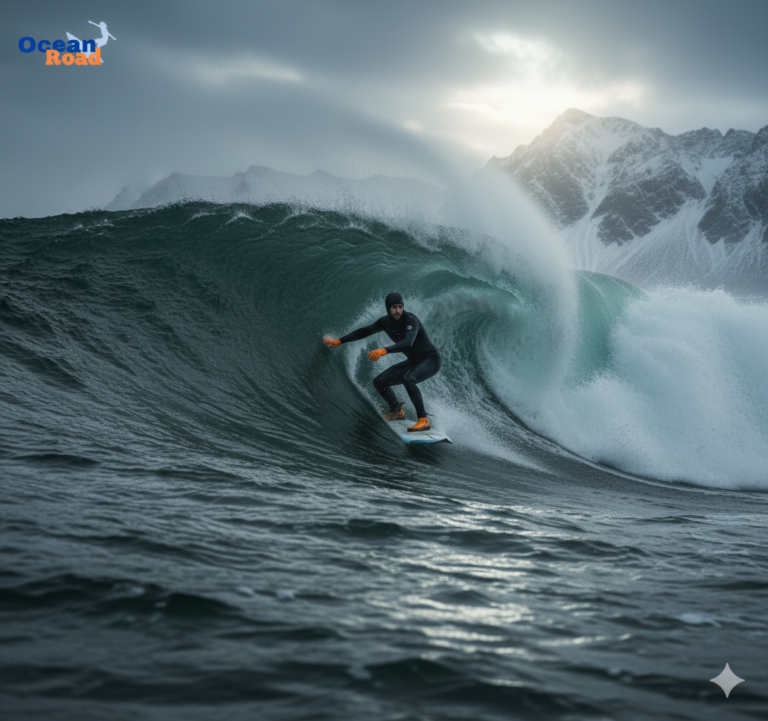
Let’s be honest: watching a pro surfer carve a wave makes it look effortless. They glide, they turn, they make the ocean look like a playground. But when you grab a board for the first time, the reality hits you like a ton of saltwater. You quickly realize that surfing is one of the most physically and mentally demanding sports on the planet.
But here is the secret: it is also the most rewarding. Beyond the physical challenge, the Benefits of Surfing for Body and Mind are life-changing, offering a rare mental reset that few other sports can match. This isn’t just another generic list of tips. This is the ultimate guide to surfing for beginners, designed to save you from the common mistakes, the exhaustion, and the frustration that make so many people quit before they even start. We are going to cover everything from choosing the right gear to understanding the ocean, because catching a wave is only 10% of the battle.
What You Need Before Touching the Water (Essential Gear)
Before you can think about riding a wave, you need the right tools. If you want a deep dive into the specifics, check out our Essential Beginner Gear Guide. The surf industry will try to sell you everything under the sun, but as a beginner, keep it simple.
The Board: Choose Stability Over Ego
When I first started, I wanted the coolest, sharpest shortboard I could find. Huge mistake. If I could summarize everything I’ve learned in these years, I’d tell you to start with a stable, thick board, even if it’s not the most attractive one on the beach. Falling into the “cool board” trap is one of the most common surfing mistakes beginners make that stalls their progress for months.
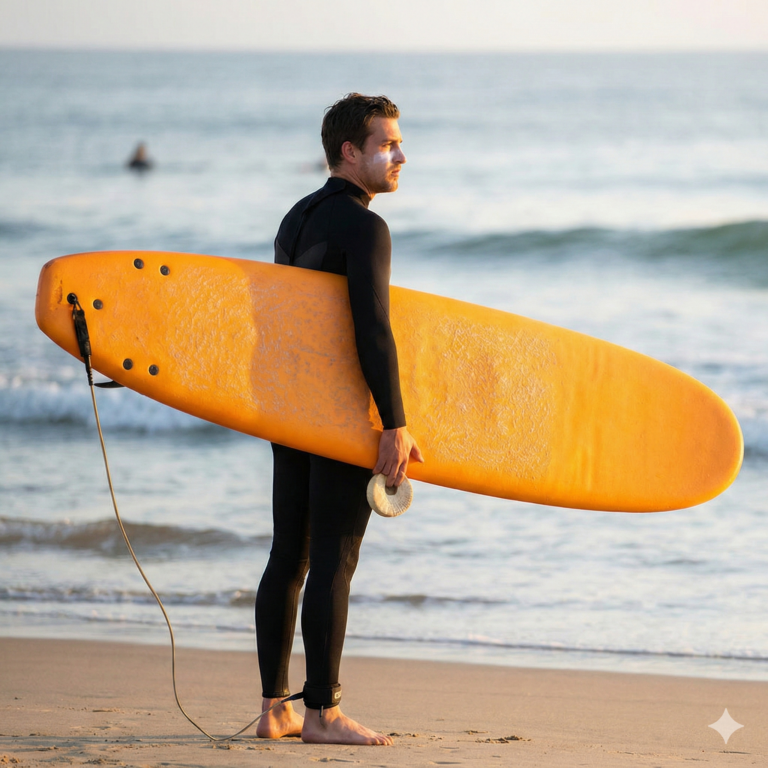
For your first few months, a foam board (softboard) between 8 and 9 feet is your best friend. Why?
Buoyancy: They float easily, making paddling less exhausting.
Stability: A wider deck gives you a massive margin of error when trying to stand up.
Safety: When (not if) the board hits you in the head, foam hurts a lot less than fiberglass.
Forget about doing radical maneuvers right now. Swallow your ego. The goal is to catch as many waves as possible and stand up. You can’t do that if you are sinking on a tiny board.
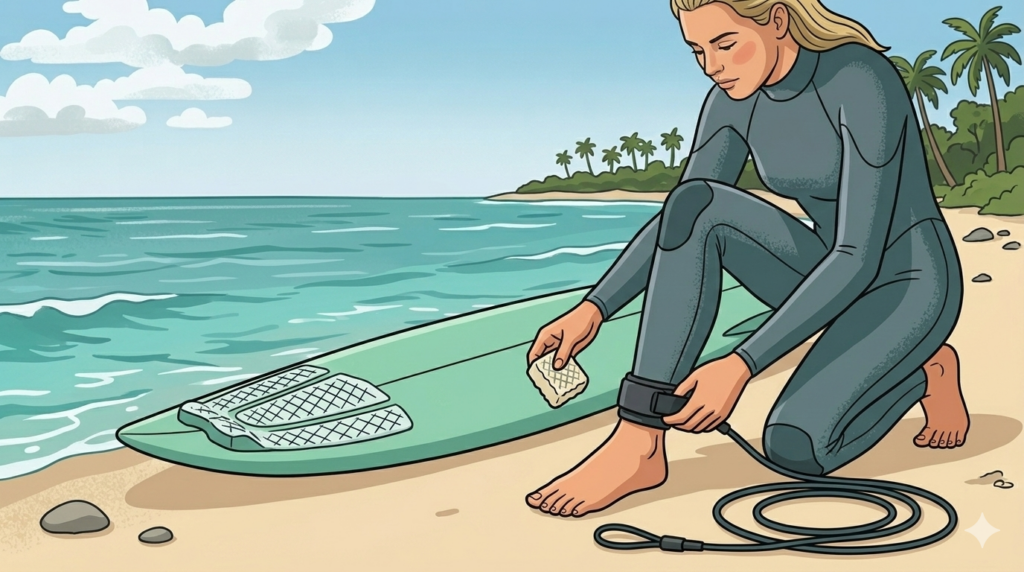
The Leash, the Wax, and the Wetsuit
The Leash: This is your lifeline. It attaches your ankle to the tail of the board. Without it, your board becomes a dangerous projectile, and you’ll spend 90% of your session swimming after it.
Surf Wax: You need traction. Apply a generous base coat and then a top coat suited for the water temperature you are surfing in.
The Wetsuit: Unless you are in tropical waters, you’ll need neoprene. Choosing what to wear surfing in different water temperatures is vital; if you are too cold or too hot, your session will end early.
Understanding the Ocean: The Most Ignored Step by Beginners
Most beginners grab their board, run into the water, and start paddling like their life depends on it. I know, because I did exactly that. What I struggled with the most at the beginning wasn’t actually standing on the board; it was understanding the water.
Learning how to read waves for beginners is a superpower. I used to exhaust myself paddling after every single bump on the horizon and always arrive late. Over time, I learned a crucial lesson: it’s not about paddling harder; it’s about being in the right place.
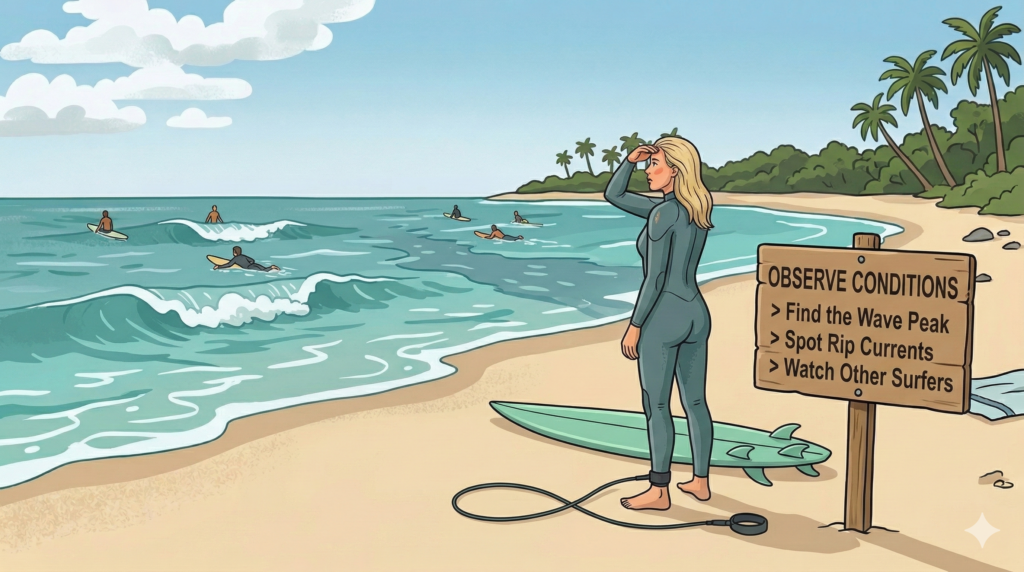
Before you even put your leash on, stand on the beach for 10 minutes and observe:
- Where are the waves breaking? Look for the “peak” (the highest point of the wave before it crashes).
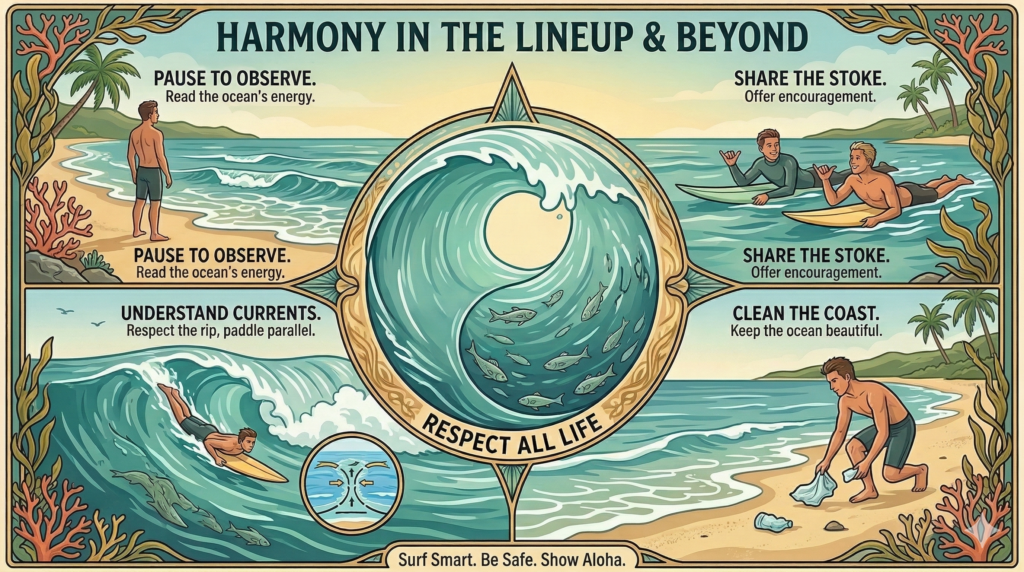
- Are there rip currents? Look for darker, calmer, or churning water moving away from the shore. Use these channels to paddle out without fighting the whitewater.
- What are the other surfers doing? Notice where the experienced guys are sitting. Don’t paddle directly into their zone, but use them as a reference point for where the waves are forming.
Learning to observe before entering the water will completely change your approach to surfing.
Step-by-Step Technique: From Paddling to Your First Ride
You have the gear. You’ve watched the ocean. Now it’s time to get wet.
Positioning and Efficient Paddling
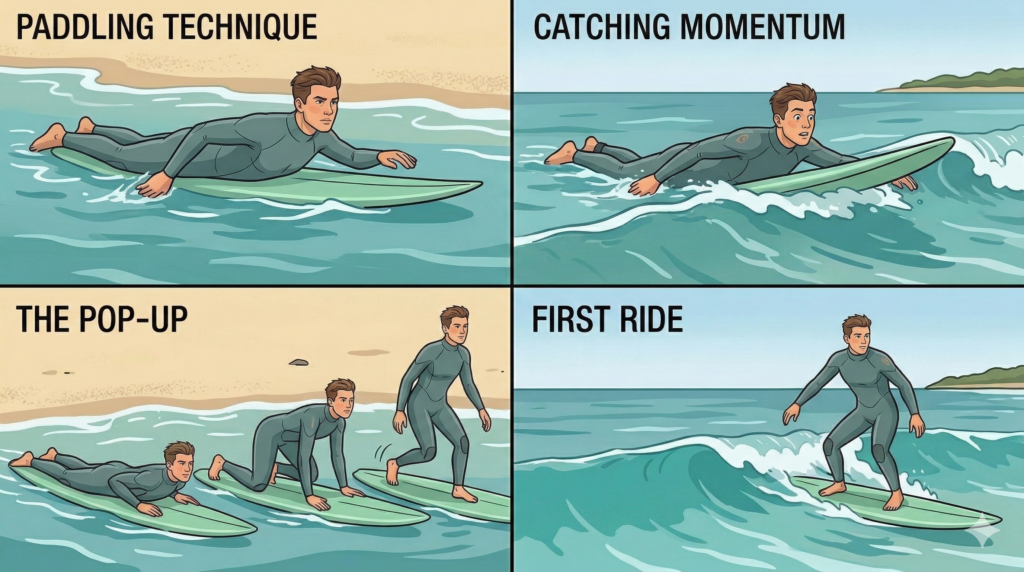
Your positioning on the board dictates everything. If you are too far forward, the nose will dig into the water (pearling). If you are too far back, the tail drags, and you’ll never catch the wave. Find the “sweet spot” where the board is perfectly flat on the water while you arch your back and keep your chest up.
When paddling, use long, deep strokes reaching down into the water, rather than short, frantic splashes. Cup your hands slightly and pull the water past your hips.
The Pop-Up: The Art of Standing Up
The “pop-up” is an explosive push-up that transitions you from your stomach to your feet in one fluid motion.
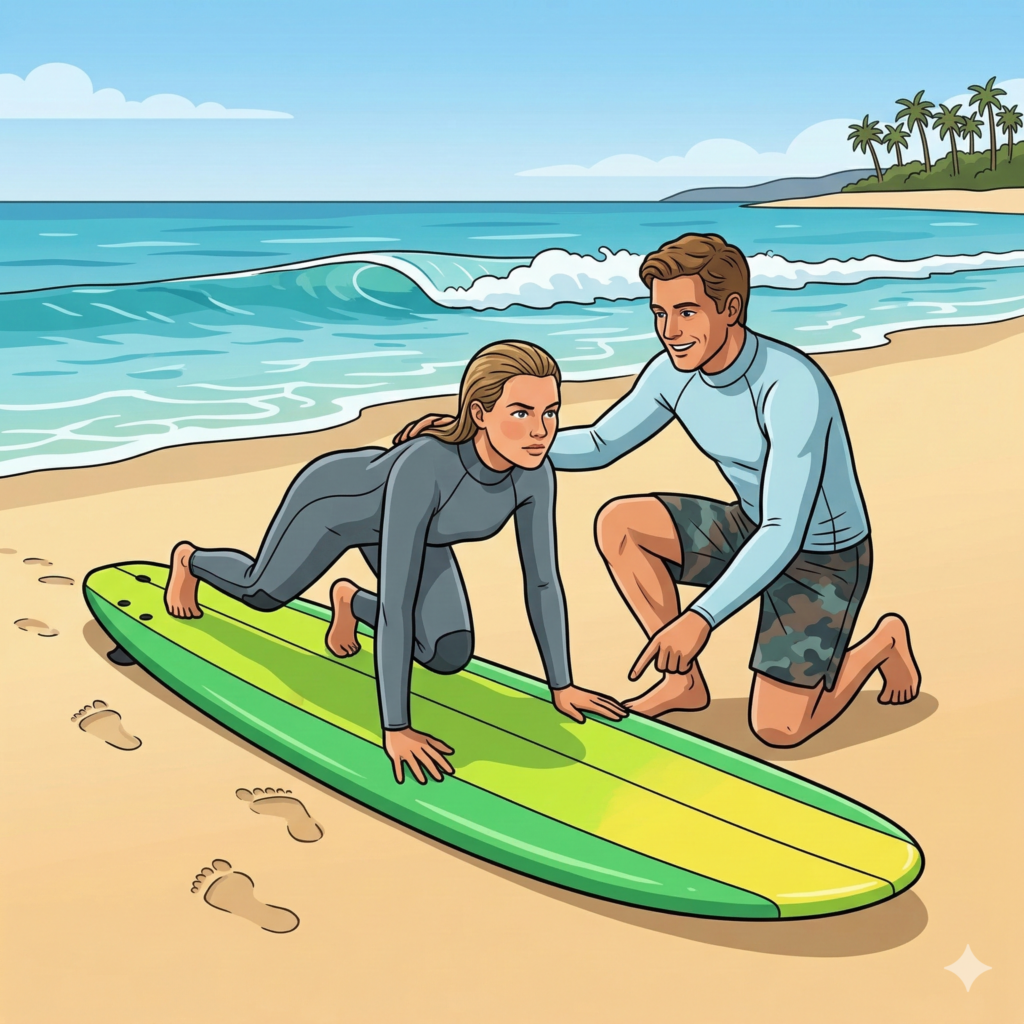
This is the foundation of your ride. To master this, follow our detailed guide on how to stand up on a surfboard step-by-step, and practice the movement on land until it becomes muscle memory.
Practice this on land. A lot.
- Place your hands flat on the deck, near your lower ribs (not holding the rails).
- Push up explosively.
- Swing your legs under you, bringing your front foot between your hands and your back foot near the tail.
- Stay low, knees bent, arms out for balance, and look straight ahead, never look down at your feet.
That First Glide
When you are ready, start in the whitewater (the broken, foamy part of the wave). Paddle towards the shore, feel the momentum of the water pick you up, and execute your pop-up.
Nothing compares to that first wave where you actually manage to stand up. I remember mine clearly. It was a small wave, nothing impressive from the outside, but when I did the pop-up and felt the board gliding, the world went completely silent. All I could hear was the water rushing under my feet. It lasted only a few seconds, but it was enough to understand why people fall in love with this. It wasn’t about speed; it was the profound sensation of being connected to something much bigger than yourself. When you get that feeling, there is no turning back.
Surviving the Wipeouts: Fear, Safety, and Respect
Surfing is dealing with an uncontrollable force of nature. You will fall, and you will get held underwater. This is why following surf safety tips for first-time surfers is non-negotiable.
When the Ocean Puts You in Your Place
I learned this the hard way. I once paddled out in waves that were too big for my level and got destroyed by a set. That day taught me that the ocean always demands respect. Underestimating the power of even a small wave is a mistake you only make once.
When you wipe out, cover your head with your arms and stay calm. The ocean is not against you; it is simply powerful. Learn to hold your breath, relax, and let the wave pass. You will pop back up to the surface in a few seconds.
Managing Fear and Breath
If someone tells me they are afraid of the ocean, I completely understand. Fear is natural and necessary because it keeps you alert. The important thing is not letting it paralyze you.
Start on beaches with sandy bottoms and small waves. Go with someone experienced, and focus on feeling comfortable in the water without the pressure of surfing perfectly. A huge part of the fear comes from losing control of your breathing when a wave tumbles you.
When you wipe out, cover your head with your arms. Don’t fight the turbulence. The ocean is not against you; it is simply powerful and indifferent. When you accept that, you stop fighting it and start flowing. Learn to hold your breath, stay calm, and let the wave pass. You will pop back up to the surface in a few seconds.
Lineup Etiquette: The Unwritten Rules
The ocean is for everyone, but the waves have a hierarchy. To avoid dangerous collisions and keep the peace, you must follow surf etiquette and the rules every surfer must know.
Don’t Drop In: The surfer closest to the peak (where the wave is breaking) has the right of way. If someone is already riding the wave, pull back.
Don’t Snake: Don’t paddle around someone to get closer to the peak and steal their right of way. Wait your turn.
Hold Onto Your Board: Never throw your board when a wall of whitewater is coming. Learn the turtle roll (for longboards/foamies) to keep control of your gear and protect others.
Apologize: If you make a mistake and get in someone’s way, a simple “I’m sorry, my bad” goes a long way.
The Journey is Slow, but Worth It
The journey of a surfer is personal and notoriously slow. You might find yourself asking, “is surfing hard to learn?” The answer is yes, but the challenge is part of the reward.
How long the process takes depends on your consistency. If you’re wondering “how long does it take to learn surfing?” the reality is that while you can stand up in a few days, mastering the ocean takes a lifetime. Focus on the small wins, enjoy the horizon, and keep paddling.
Frequently Asked Questions (FAQ) for Beginner Surfers
Where are the best places for beginners to start?
You want a beach with a sandy bottom and gentle, rolling waves. Check out our list of the best beaches for beginner surfers to find a spot that matches your current skill level.
How long does it actually take to learn how to surf?
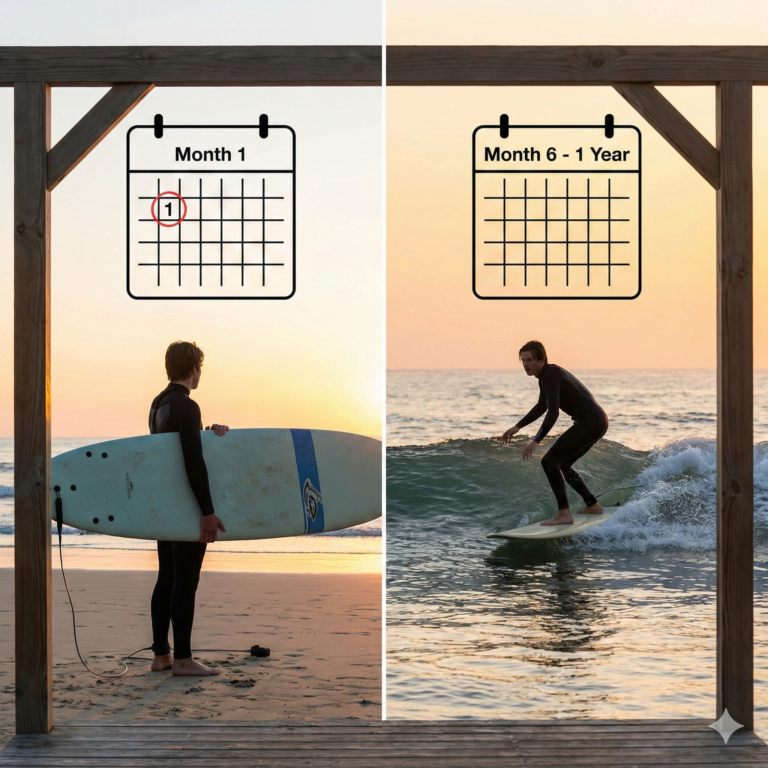
It depends entirely on your consistency, fitness level, and the conditions you surf in. If you practice consistently (2-3 times a week), you can learn to pop up and ride whitewaters comfortably in a few weeks. However, catching unbroken “green” waves consistently and learning basic turns usually takes anywhere from six months to a year. Remember, surfing has one of the steepest learning curves of any sport.
What is the difference between a “duck dive” and a “turtle roll”?
Both are techniques used to get past breaking waves while paddling out, but they are used for different boards:
Turtle Roll: Used with longboards and thick foam boards (softboards) that are too buoyant to sink. You grab the rails (edges), flip the board upside down so you are underwater and the board is on top, and hold on tight while the wave washes over the hull.
Duck Dive: Used with shortboards (typically under 7 feet). You push the nose of the board deep underwater and use your knee or foot on the tail to sink the rest of the board, allowing the wave’s energy to pass over you.
Why do I keep “pearling” (nose-diving) when trying to catch a wave?
Pearling happens when the nose of your surfboard digs into the water, usually sending you flying over the handlebars. This is caused by three main beginner mistakes:
- Poor Positioning: You are lying too far forward on the board.
- Paddling Too Slow: If you don’t match the speed of the wave, the wave will pick up the tail of your board and push the nose down.
- Late Takeoff: Trying to catch the wave when it is already too steep. You need to catch it earlier in its formation.
Do I really need to take surf lessons, or can I teach myself?
While it is possible to teach yourself, taking at least one or two professional lessons is highly recommended. An instructor will correct dangerous habits (like placing your hands on the rails during a pop-up), teach you crucial ocean safety (identifying rip currents), and help you choose the right initial equipment. Self-teaching often leads to a slower progression and a higher risk of injury or frustrating wipeouts.