Surfboard fins are one of those things you completely ignore at the beginning… and then one day you change them and realize they actually matter way more than you thought. In the world of surfing, we often obsess over volume or the shape of the board, but the fins are the elements that actually dictate how that board connects with the water.
Think of your board as a high-performance car; the shape is the body, but the fins are the tires. If you have the wrong tires for the terrain, you’re going to slide out or lose speed. Before you start dropping money on accessories, it’s vital to have your baseline equipment sorted. If you haven’t yet, check out our How to Choose the Right Surfboard Guide . Once you have your board, fins are your primary tool for “fine-tuning” your ride.
The “Aha!” Moment: Why Fins Matter More Than You Think
I remember perfectly the first time I swapped those cheap, flexible plastic fins for a proper fiberglass set. At the start, I didn’t even think about it. Fins were just… there. Whatever came with the board was fine. But once I changed them, the feeling was immediate.
From Plastic to Fiberglass: Feeling the Connection
With the plastic fins, I felt like the tail of the board would slide unpredictably if I pushed too hard. It felt “mushy.” However, as soon as I put on a stiffer fiberglass set, everything became solid. It wasn’t that I suddenly became a better surfer overnight, but the board started responding with more honesty to what I was trying to do. For the first time, I felt like the board was actually connected to the wave instead of just skimming over it. This connection” is what allows you to start generating your own speed rather than just waiting for the wave to push you.
The Control You’re Missing: Why Your Board “Slips” in Turns
If you feel like your board lacks “hold” or you lose speed when trying to turn, your fins are likely too flexible for your weight or current skill level. High-quality fins provide Drive (acceleration) and control. When you leave the soft material behind, your turns feel cleaner and more deliberate. You stop “guessing” if the board will hold the line and start trusting that it will do exactly what you ask of it.
Understanding Setups: Thruster, Quad, and Single Fin
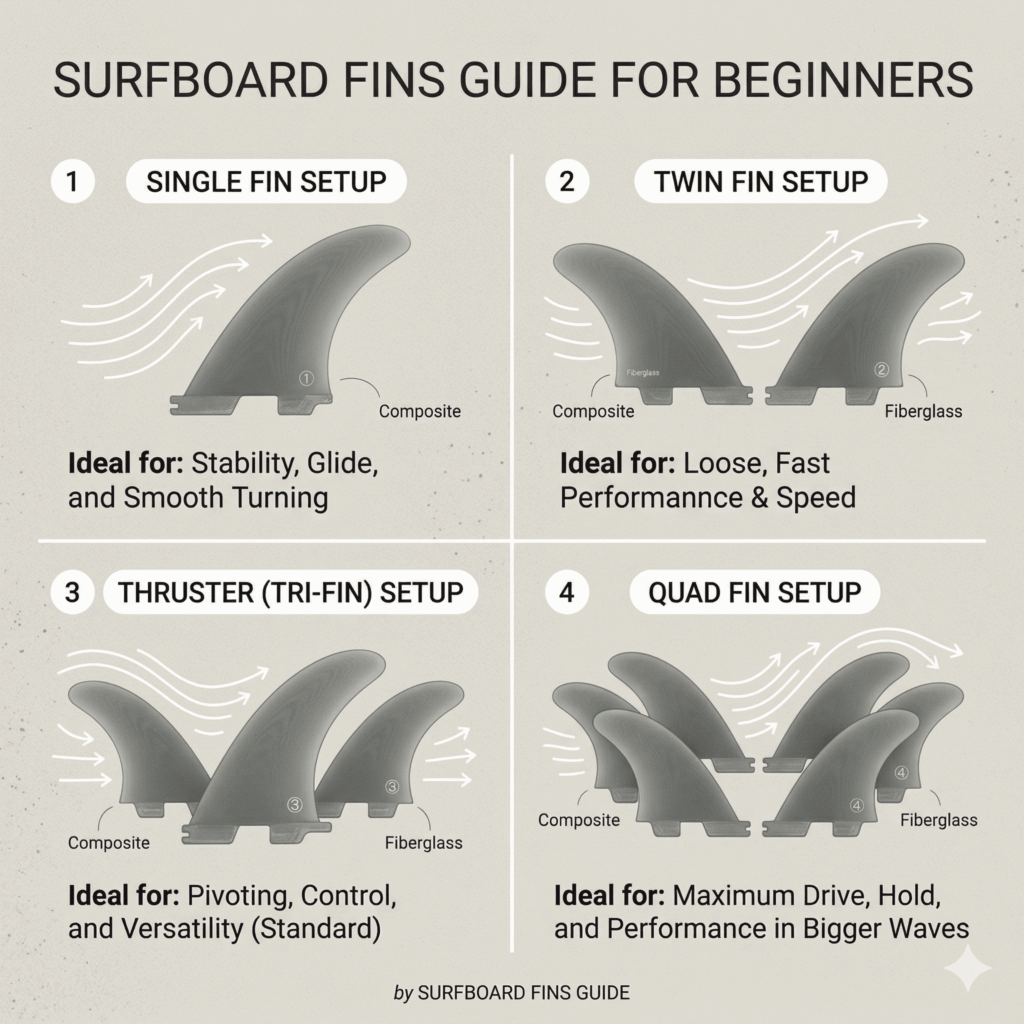
As you progress, you’ll start experimenting with different configurations. Each one drastically changes your board’s personality and how it interacts with different wave types.
Thruster (3 Fins): The Gold Standard
The classic thruster setup, with three fins, is what most people ride, and for good reason. This is what I used the most while progressing. It’s balanced, predictable, and works in almost any condition. The center fin provides a stable pivot point, making it the best choice for learning technical, vertical turns. If you want a board that feels centered, the thruster is your go-to.
Quad (4 Fins): Extra Speed for Mushy Days
I tried a quad setup on smaller, weaker days, and the feeling was completely different. Without a center fin, water flows much faster through the middle of the board, giving you massive down-the-line speed. It’s faster and has more drive, but it can also feel a bit “looser” or “skatier” in certain situations. It took me a while to adjust, but once I did, it opened up new ways of surfing softer waves that would otherwise feel boring.
Single Fin: The Masterclass in Style
Switching to a single fin is a whole different world. It’s slower and entirely about flow and positioning rather than sharp, aggressive turns. It forces you to surf differently, more smoothly and more deliberately. It’s the ultimate way to learn how to read the “trim line” of a wave.
Beginner Survival Guide: When Should You Buy New Fins?
Here is the honest advice I’d give to any beginner who just bought their first board:don’t stress about fins right away. Seriously. At the beginning, your focus should be 100% on paddling, positioning, catching waves, and standing up. That’s where all your progress is going to come from.
Why You SHOULDN’T Overthink Fins at the Start
The difference between cheap fins and high-end fins exists, but it’s not going to be the thing holding you back in your first few months. You need to develop a “feel” for the wave before you can appreciate the technical nuances of fin foil or rake.
Safety First: The Advantage of Soft Fins
What does matter is that your fins are safe. If you’re on a foam board, soft or flexible fins are actually better at the start. They significantly reduce the risk of injury to yourself and others when you inevitably lose control of the board. Only once you start feeling comfortable on the wave face and begin putting real pressure on your rails does it make sense to move toward fiberglass or carbon fins.
Comparison: Which Setup Should You Choose?
| Configuration | Primary Feeling | Best For… | Suggested Level |
| Thruster (3) | Balance & Control | All-around conditions; learning turns. | All (especially progressing) |
| Quad (4) | Speed & Drive | Weak, mushy waves or fast barrels. | Intermediate / Advanced |
| Single Fin | Style & Flow | Long, peeling waves; soul surfing. | Intermediate (for style) |
| Twin Fin (2) | Loose & Fun | Small summer waves; “skaty” feel. | Intermediate / Advanced |
Fins Amplify Your Fundamentals
At the end of the day, fins are like fine-tuning a guitar. They won’t fix “bad” surfing or poor fundamentals, but once your basics are solid, they can really enhance how your board feels under your feet. Keep it simple at the start. Focus on the ocean and your movement. The time for obsessing over fin materials and setups will come… and when it does, you’ll actually feel the difference instead of just guessing.
Frequently Asked Questions
Should I buy FCS II or Futures fins?
This depends entirely on the “fin boxes” (plugs) installed in your board. They are not interchangeable. FCS II fins click in without tools (usually), while Futures use a single screw and a full-length base. Check your board before buying.
What is “Fin Cant”?
Cant refers to the angle the side fins make in relation to the bottom of the board. More cant allows for more responsive turning, while less cant (fins pointing straighter up) provides more speed in a straight line.
Does fin size matter?
Yes. Fins are sized (S, M, L) based on the surfer’s weight. If you use fins that are too small, you’ll slide out. If they are too large, the board will feel stiff and hard to turn. Always check the manufacturer’s weight chart.