Table of Contents
Surfboard volume is one of those topics that sounds incredibly technical, but once you’ve been in the water long enough, you realize it’s both vital and a little overhyped at the same time.
If you’ve spent any time in a lineup, you’ve probably heard surfers arguing over one or two liters of volume like it’s life or death. They talk about numbers like they’re tuning a race car, saying things like, “This board is 31.5 liters, but I usually ride 30.8,” as if that tiny difference is the magic key to a perfect session.
While those small adjustments matter for pros, for most of us, volume is a guide—not a guarantee. Before you get lost in the math, make sure you understand the basics in our How to Choose Surfboard Size Guide. If you’re ready to look past the numbers, here is the truth about surfboard volume.
The “Surfboard Volume Lie”: Why Identical Liters Feel Different
I’ve owned two boards with almost identical volume (same liters, similar length) where one felt like a dream and the other felt like a brick. One was alive, responsive, and easy to paddle; the other was slow, awkward, and impossible to position.
This is what I call the Volume Lie. Volume tells you how much a board floats, but it doesn’t tell you how it will feel under your feet or under your chest when you’re paddling.
Two boards can carry the exact same 35 liters, but the way that foam is distributed,through the nose, under your chest, or in the rails, changes everything. If the foam is concentrated under your chest, the board will glide into waves effortlessly. If it’s shoved into chunky rails or an oversized tail, it might feel “corky” and difficult to control. Volume is just a measurement of displacement; distribution is what dictates performance.
The Magic of “Hidden Volume”
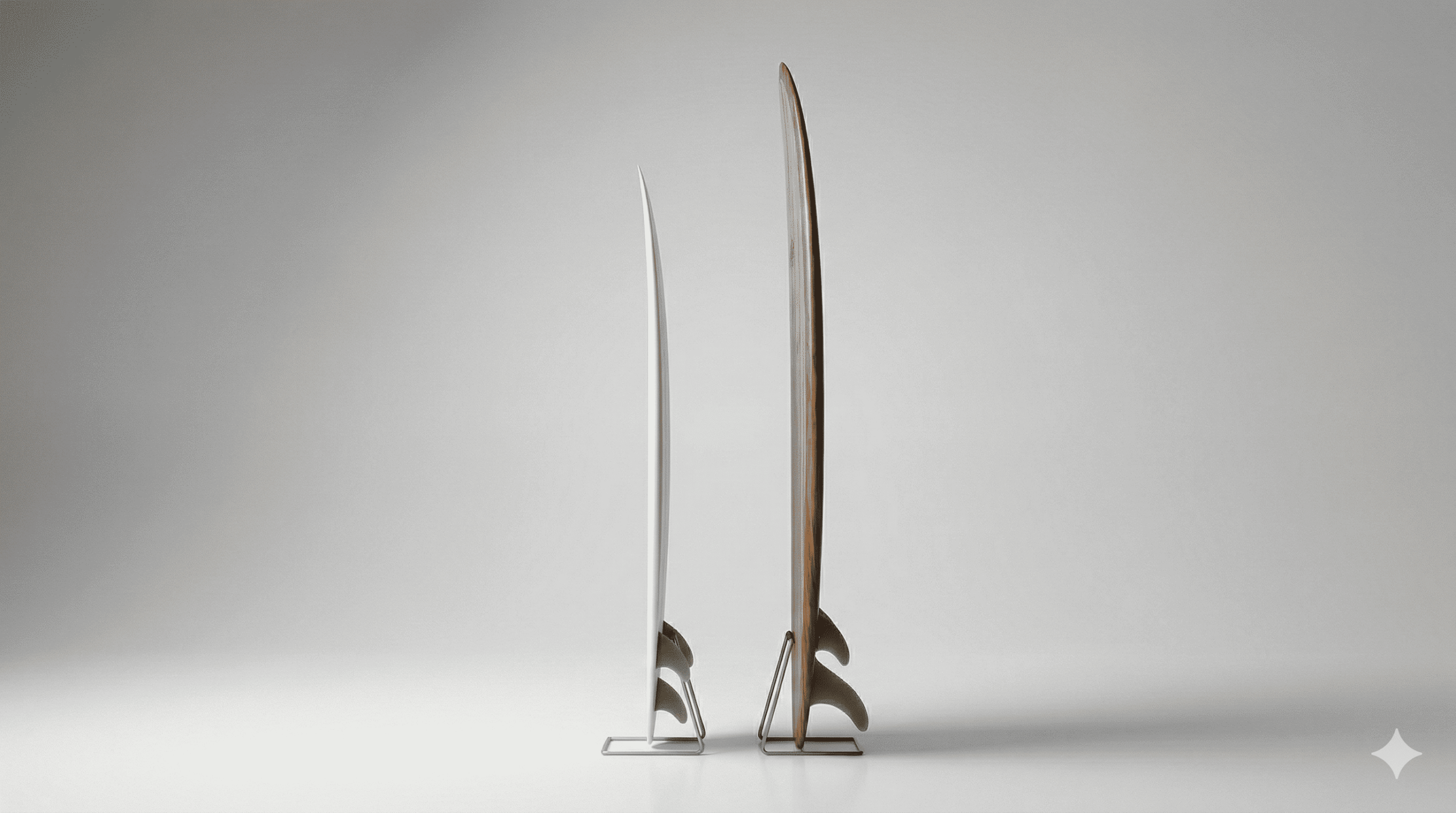
We’ve all seen those boards,the ones that look sleek, thin, and high-performance, yet they stay high on the water and catch everything. This is “Hidden Volume”.
Smart shapers know how to hide foam where you actually need it (usually under the chest for paddling) while keeping the rails tapered and the nose refined. It’s the ultimate “cheat code” for surfers who want a board that looks like a sports car but paddles like an SUV. It’s not just about cramming foam into a board; it’s about placing it where it actually helps you stay stable and get into waves early.
Volume Distribution: How Foam Affects the Ride
| Foam Placement | The Feeling | Best For | The Drawback |
| Under the Chest | “The Paddle Hack” | Catching waves early and easy gliding. | Can make the front of the board feel “heavy” in turns. |
| In the Rails | “The Safety Net” | Extra stability and forgiveness during turns. | Thick rails are harder to “sink” into the wave face for grip. |
| In the Tail | “The Turbo” | Maintains speed through flat or weak sections. | Can make the board feel “bouncy” in powerful surf. |
Beyond the Number: Rocker, Rails, and Outline
When I hear people obsessing over a one-liter difference, I realize they might be missing the bigger picture. Volume is a great starting point to ensure you aren’t sinking, but it’s heavily influenced by other factors:
- Rocker: A board with a lot of curve (rocker) pushes more water and can feel like it has “less” volume when paddling than a flat board.
- Outline: A wide, round nose adds a level of stability that liters alone can’t describe.
- Fitness: A pro might ride 28 liters because their technique is perfect, but a beginner might need 80 liters to achieve the same result.
The Bottom Line
The best board I’ve ever ridden wasn’t the one with the “perfect” volume number on the stringer. It was the one that felt right in the water, easy paddle, smooth takeoff, and responsive when I needed it.
Until you get a board in the ocean and feel how it moves, volume is just a number. Use it to find your “safety margin,” but don’t let a decimal point talk you out of a board that feels like magic.
Frequently Asked Questions
What exactly is surfboard volume?
Volume is a measurement (typically in liters) of the total amount of space the interior of a surfboard occupies. It is calculated by multiplying length, width, and thickness, adjusted for the board’s specific shape and curves.
Why do beginners need high-volume boards?
Beginners need high volume because it provides maximum buoyancy. This keeps the board high on the water, making it significantly easier to paddle, catch waves, and maintain balance during the pop-up.
Can a board have too much volume?
Yes. If a board has too much volume for your weight or the wave conditions, it can feel “corky” or bouncy. This makes it difficult to engage the rails of the board in the water to make a turn, especially in larger or more powerful waves.