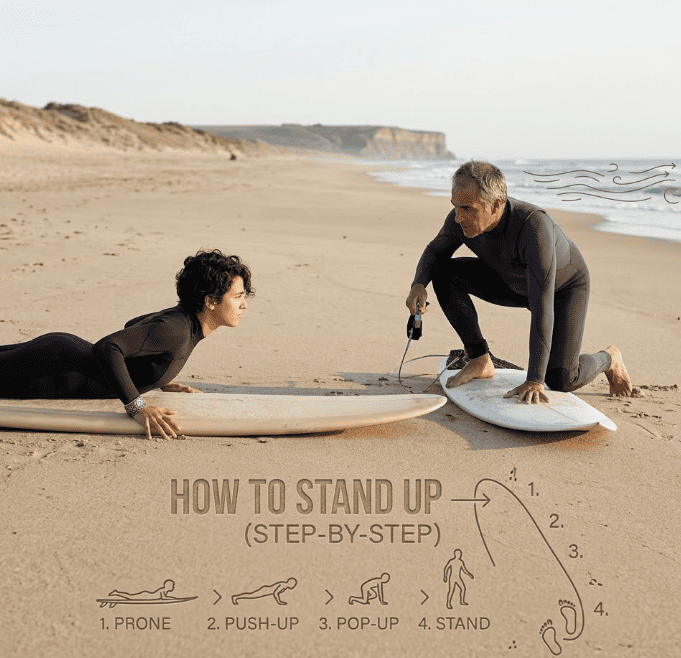
If there is one thing every beginner obsesses over, it’s the pop-up. Learning how to stand up on a surfboard feels like trying to master a secret martial arts move. You watch the pros do it, and it looks instantaneous a fluid, effortless transition from lying down to riding the wave.
But when you are out there in the water, it feels like chaos. You think the pop-up is the hardest part of surfing, and you assume it requires massive upper body strength.
The truth? It is not about doing it perfectly, and it is certainly not about muscle. It is about doing it naturally. And that only comes after a lot of messy attempts. Let’s break down the true mechanics of the pop-up, the massive mistakes almost everyone makes, and how to finally find your feet.
The Hard Truth About the Pop-Up: Commitment Over Strength
The biggest misconception about standing up on a surfboard is that you “stand up.” You don’t. You explode into position in one smooth motion.
When you try to slowly stand up, your weight shifts unevenly, the board wobbles, and you fall. The pop-up is about timing and absolute commitment, your hands press against the deck, you push up, bring your feet under you, and land ready, There is no halfway point.
The Biggest Beginner Trap: Using Your Knees
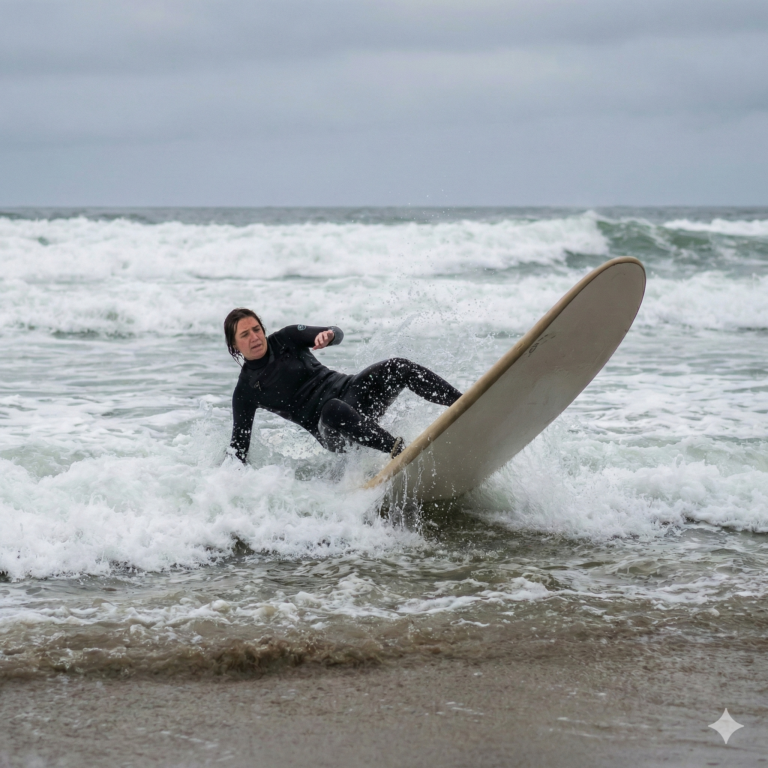
When I first started, I fell into the most common beginner trap in the world: I used my knees. Almost everyone does it. You catch the wave, panic sets in, and instead of popping up in one fluid motion, you drag one knee up, then the other, and then you try to stand.
It feels safer. It feels like you have more control because you are keeping your center of gravity low. But it is an absolute trap, and I got stuck there for a long time.
The problem with the “knee pop-up” is that it is too slow. By the time you are finally on your feet, the wave has already moved on, you lose your speed, you lose your balance, and you ruin your timing. Breaking that habit took serious effort, I had to force myself to fail over and over again, committing to going straight to my feet, even if it meant wiping out every single time.
If you are currently using your knees, stop today. Accept the wipeouts until you build the muscle memory to bypass your knees entirely.
Step-by-Step: How to Do a Proper Pop-Up
You don’t learn the pop-up by overthinking it; you learn it by repeating the correct mechanics until your body takes over. Here is the step-by-step breakdown.
Step 1: The Glide (Don’t Rush It)
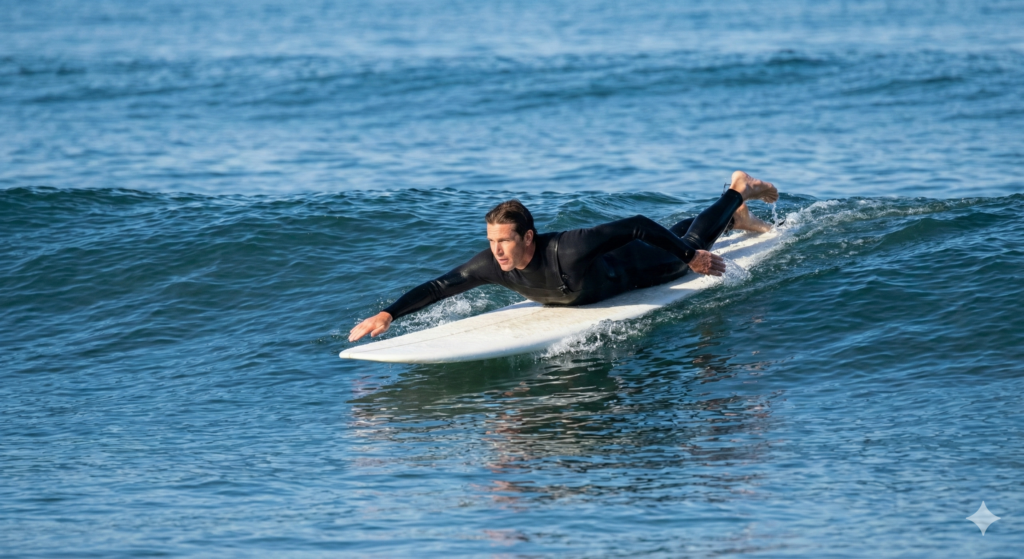
My real “aha” moment didn’t come on a big wave or a perfect day. I remember catching a small, clean wave, and instead of rushing the pop-up out of panic, I just let the board glide for a second.
You need to feel the wave catch the board. Paddle hard, and when you feel the tail lift and the board start to accelerate on its own, give it one more strong paddle. Then, let it glide for a split second to stabilize before you initiate the pop-up.
Step 2: Hand Placement (Under the Pectorals)
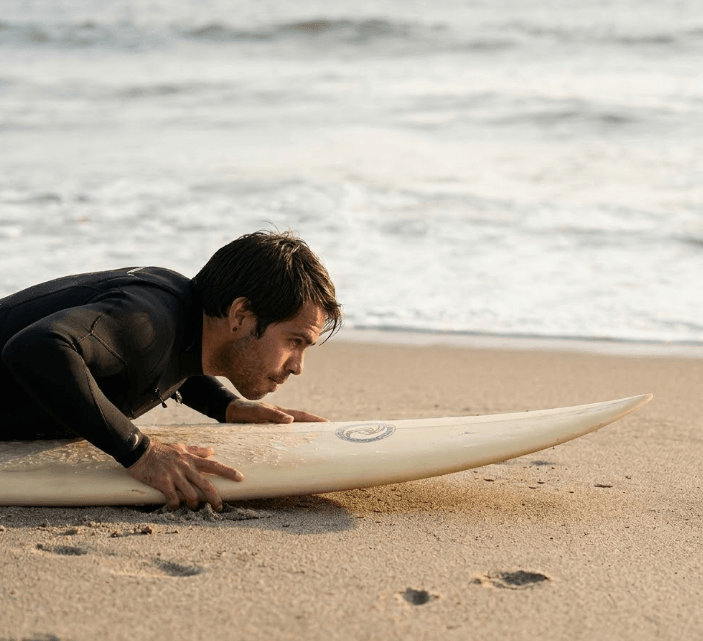
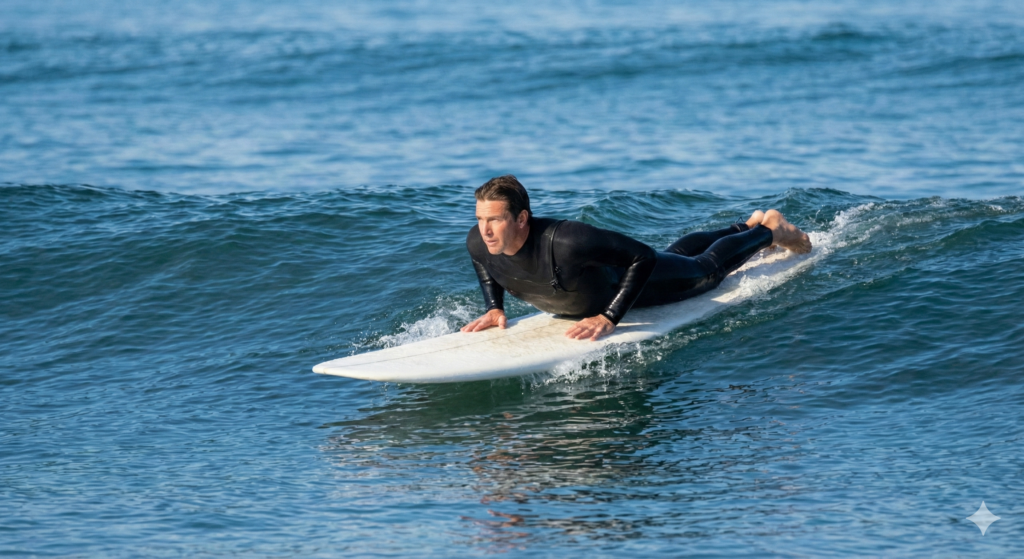
Place your hands flat on the deck of the board, right next to your lower ribcage/pectorals. Do not grab the rails (the edges) of the board, If you grab the rails, you will inevitably pull unevenly, causing the board to flip. Keep your hands flat on top of the board.
Step 3: The Explosive Push (One Smooth Motion)
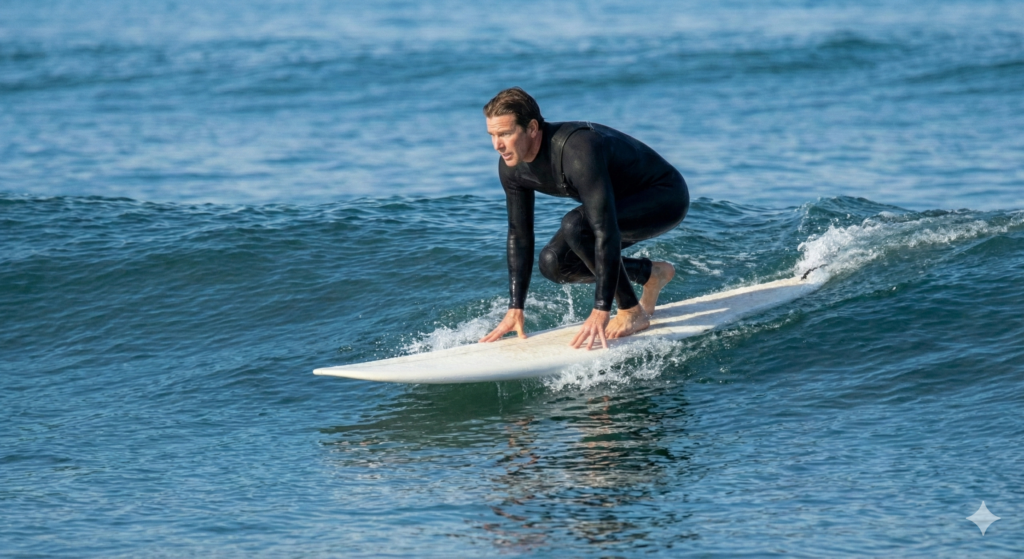
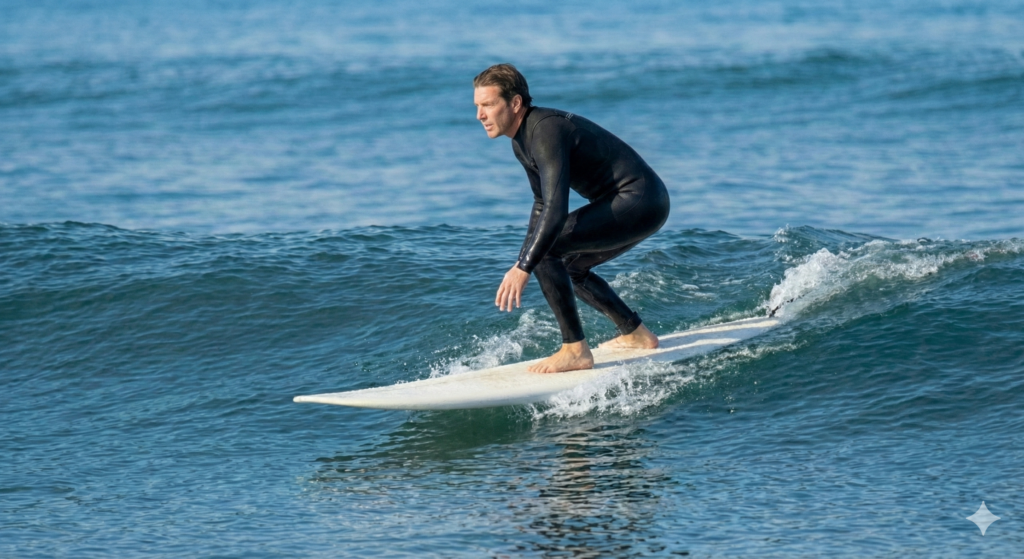
Push up explosively with your arms, creating space between your body and the board. In that exact same split second, swing your hips and bring both feet under your body simultaneously. Your back foot should land near the fins, and your front foot should land near the middle of the board, perfectly centered over the stringer (the line down the middle of the board).
I remember the first time I did this right, no hesitation, no extra movements. Everything just felt… quiet. Balanced. My body finally understood what to do without me forcing it.
Step 4: Eyes Forward, Never Down
I made this classic mistake for weeks: looking down at my feet. I thought I needed to see where I was placing them to get it right but every time I looked down, I would nose-dive (pearl), the front of the board would sink, and I would get launched over the handlebars.
It took me way too long to understand a fundamental rule of surfing: your body follows your head, if you look down, your weight shifts forward, and you go down. If you look forward down the line of the wave, your body naturally aligns, and your weight stays centered. Keep your eyes up!
Put It All Together: Your Next Steps
After that first successful pop-up, things will start to flow. Not perfectly, and not on every wave, but enough to feel the difference. One day, without even realizing it, you will stop struggling to stand up, and you will finally start surfing.
However, a great pop-up is useless if you don’t know which waves to catch or how to paddle into them properly. The pop-up is just one piece of the puzzle.
To make sure you are positioning yourself correctly in the ocean and reading the waves right before you even attempt to stand, head over to our Ultimate Guide to Surfing for Beginners: How to Start and Not Give Up. It covers all the foundational skills you need so that when it is time to pop up, you are already set up for success.
Surfers Frequently Ask
Why do I keep falling off as soon as I stand up?
This usually happens for two reasons: you are either looking down at your feet (which throws your balance off and causes a nose-dive), or your feet are landing off-center. Your feet must land directly over the “stringer” (the wooden line running down the middle of the board) to keep the board stable.
Can I practice the pop-up out of the water?
Absolutely. Practicing your pop-up on dry land (in your living room or on the beach before paddling out) is one of the best ways to build muscle memory. Do 10 to 20 pop-ups every day on a yoga mat. Once your muscles know the exact movement, it becomes much easier to execute it in the water when your adrenaline is pumping.
How do I know if I am goofy or regular footed?
“Regular” means you surf with your left foot forward, while “Goofy” means you surf with your right foot forward. To figure it out, stand with your feet together, close your eyes, and have a friend gently push you forward from behind. The foot you naturally step out with to catch your balance is almost always your front foot on a surfboard.