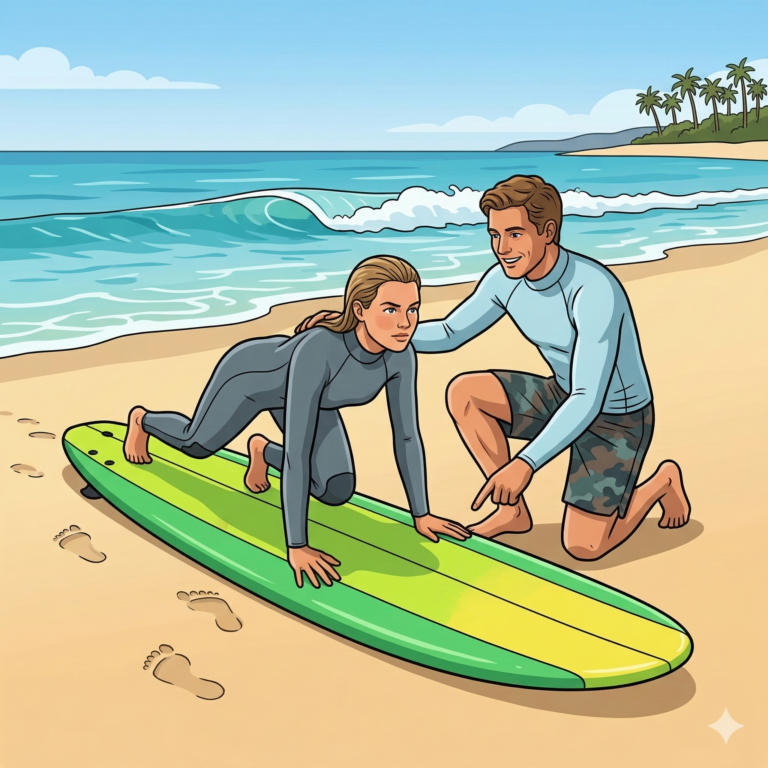
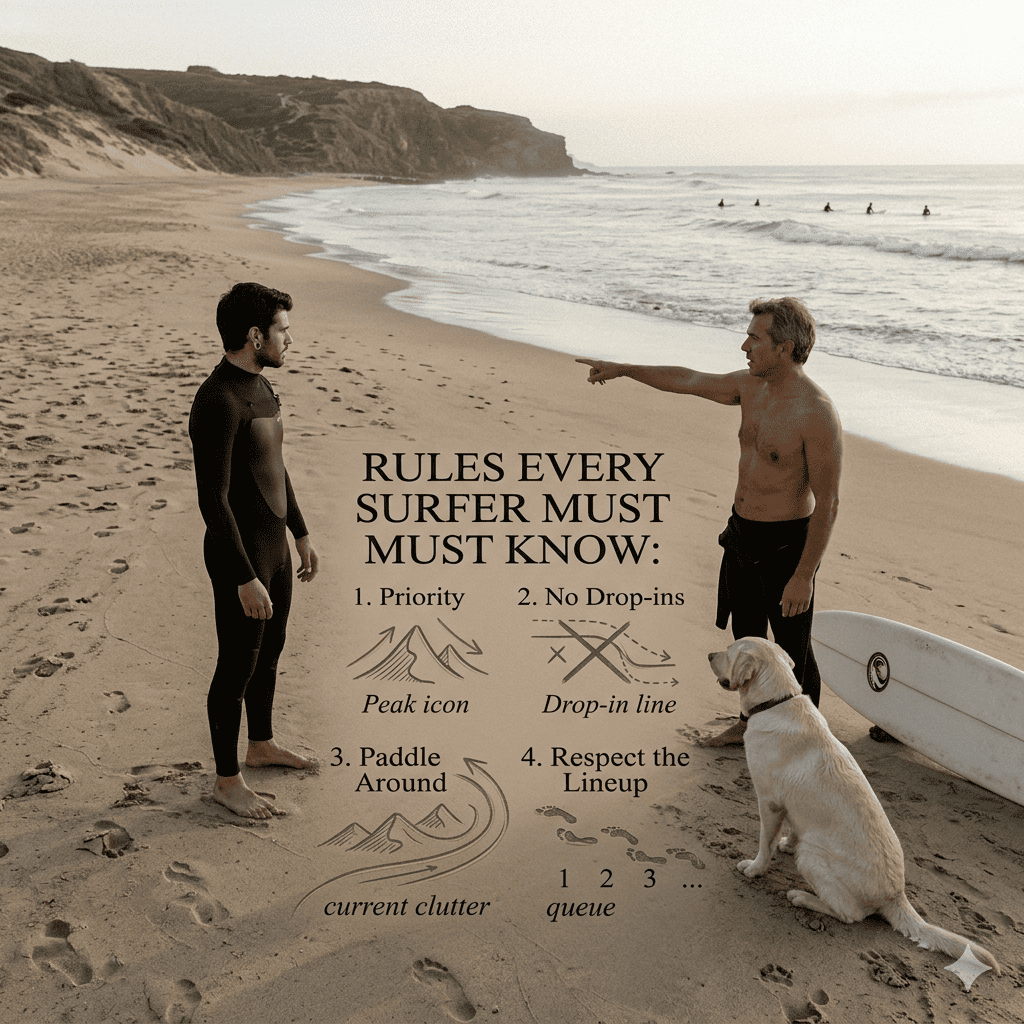
When you first start surfing, everyone focuses on teaching you how to paddle, how to pop up, and how to balance. But there is a massive piece of the puzzle that nobody properly explains until it’s too late: in the ocean, it’s not just you and the waves. There are other people, and with them come the unwritten rules of the lineup, the famous “surf etiquette.”
Let me be clear right from the start: ignoring these rules won’t just make you unpopular, it can be incredibly dangerous.
I learned this the hard way. Before you try to execute the perfect turn or catch the biggest wave of the day, you need to learn how to exist in the water. Here are the absolute, non-negotiable rules of surf etiquette, born from the mistakes I made so you don’t have to.
Why Etiquette is About Survival, Not Just Politeness
Rule 1: Understand Priority (Don’t “Drop In”)
The most sacred rule in surfing is the right of way. The rule is simple: the surfer closest to the peak (the breaking part of the wave) has priority. If someone is already up and riding, or is closer to the curl than you, you must stop paddling.
In my early days, I had no idea how priority worked. I remember paddling furiously for a beautiful wave, completely focused on the horizon, without looking over my shoulder, I popped up right in the path of another surfer who was already speeding down the line. I got yelled at, I panicked, we both fell, and we narrowly avoided a serious collision.
I didn’t do it out of malice; I did it out of pure ignorance but the ocean doesn’t care about your intentions. I paddled back to the beach feeling terrible, like I didn’t belong there, that day I realized that looking left and right before catching a wave is a matter of safety, not just manners.
Rule 2: Never Ditch Your Board (Ever)
When you are a beginner paddling out, your natural instinct when a massive wall of whitewater approaches is to let go of your board and dive underneath. Do not do this.
The ocean taught me this lesson forcefully, one day, a set of waves came through that was much larger than I expected. Instead of pushing through the foam or attempting a turtle roll, panic took over and I ditched my board. The wave caught my board, stretched my leash to its absolute limit, and launched my heavy foam board backward like a missile. It nearly hit another surfer who was paddling out right behind me.
Thankfully, no one was hurt, but it could have been catastrophic, that moment changed my perspective forever: your surfboard is not just your tool; it is your responsibility, you must maintain control of it at all times.
Rule 3: Don’t Be a Snake (And How to Handle Wave Hogs)
“Snaking” is when a surfer deliberately paddles around someone who has been waiting patiently, just to get closer to the peak and steal priority.
As a beginner, I got “snaked” more times than I can count, people would see that I was a novice, paddle right past me, and take off on the wave I was perfectly positioned for. Initially, it frustrated me deeply. It felt incredibly unfair.
Over time, I realized that while getting snaked is part of the game, there is a distinct difference between someone who doesn’t know the rules and someone who just doesn’t respect them. The solution isn’t to yell or fight; the solution is to learn how to position yourself better. As your skills improve, you learn to hold your ground, sit in the right spot, and project confidence, when you show that you know what you are doing, the wave hogs naturally back off.
Rule 4: Apologize When You Mess Up
You are going to make mistakes. You will accidentally drop in on someone, you will get in the way of someone’s ride, and you will blow a takeoff.
When it happens, a simple, genuine apology goes a long way. Lifting your hand and saying “My bad, I’m sorry!” instantly defuses the tension. Surfers are generally forgiving if they see that you are actively trying to learn and respect the rules. Acknowledging your mistake immediately changes the vibe in the lineup from hostile to understanding.
The Golden Rule: The Best Surfer in the Water…
Over the years, you realize that surf etiquette is not just a rigid set of rules; it is fundamentally about respect. Respect for the raw power of the ocean, respect for the people sharing it with you, and respect for yourself.
Looking before you paddle, controlling your board, giving people their space, and apologizing when you mess up, these are basic concepts, but they are the glue that holds the lineup together. When everyone follows them, the atmosphere in the water is pure magic, when they don’t, the tension is palpable.
Ultimately, being a good surfer isn’t just about doing cutbacks or riding big waves. It is about knowing how to carry yourself in the water. Because the best surfer in the lineup isn’t the one who catches the most waves; it’s the one everyone else is happy to have sitting next to them.
Learn the Basics Before You Paddle Out
Knowing the rules of the road is useless if you don’t know how to drive the car. Before you paddle out into a crowded lineup and worry about priority, you need to make sure your fundamental skills are sharp.
If you want to build the confidence to paddle out, catch your own waves, and safely navigate the lineup, head over to our Ultimate Guide to Surfing for Beginners: How to Start and Not Give Up. It covers all the essential techniques you need to control your board and start having fun without getting in anyone’s way.
Frequently Asked Questions About Surf Etiquette
What does it mean to “drop in” on someone?
Dropping in means catching a wave that someone else is already riding or is about to catch from a position closer to the breaking part of the wave (the peak). The person closest to the peak always has the right of way. Dropping in is the biggest taboo in surfing because it ruins the other person’s wave and often causes collisions.
What should I do if a big wave is coming and I can’t duck dive?
If you are on a large foam board or longboard and cannot duck dive under a breaking wave, you should perform a “turtle roll” (flipping the board upside down and holding tightly to the rails while underwater). Never just let go of your board and dive; your leash will stretch, and your board will fly back and hit anyone paddling behind you.
Who has the right of way if a wave peaks in the middle and breaks both ways?
If a wave is an “A-frame” (peaking in the middle and breaking both left and right equally), two surfers can ride it at the same time, one going left and one going right. Before taking off, surfers will usually communicate by calling out “Going left!” or “Going right!” to avoid crossing paths.